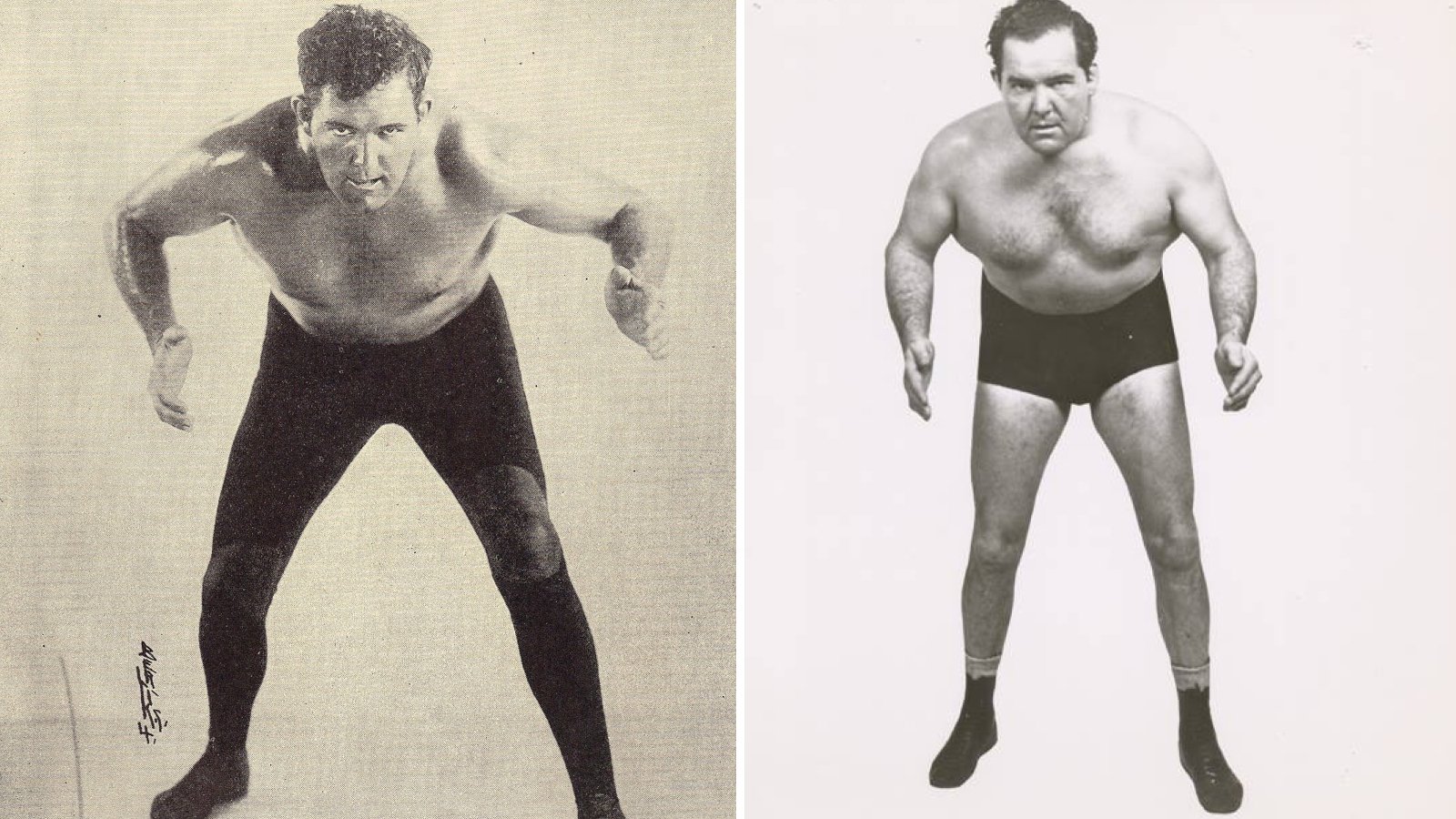
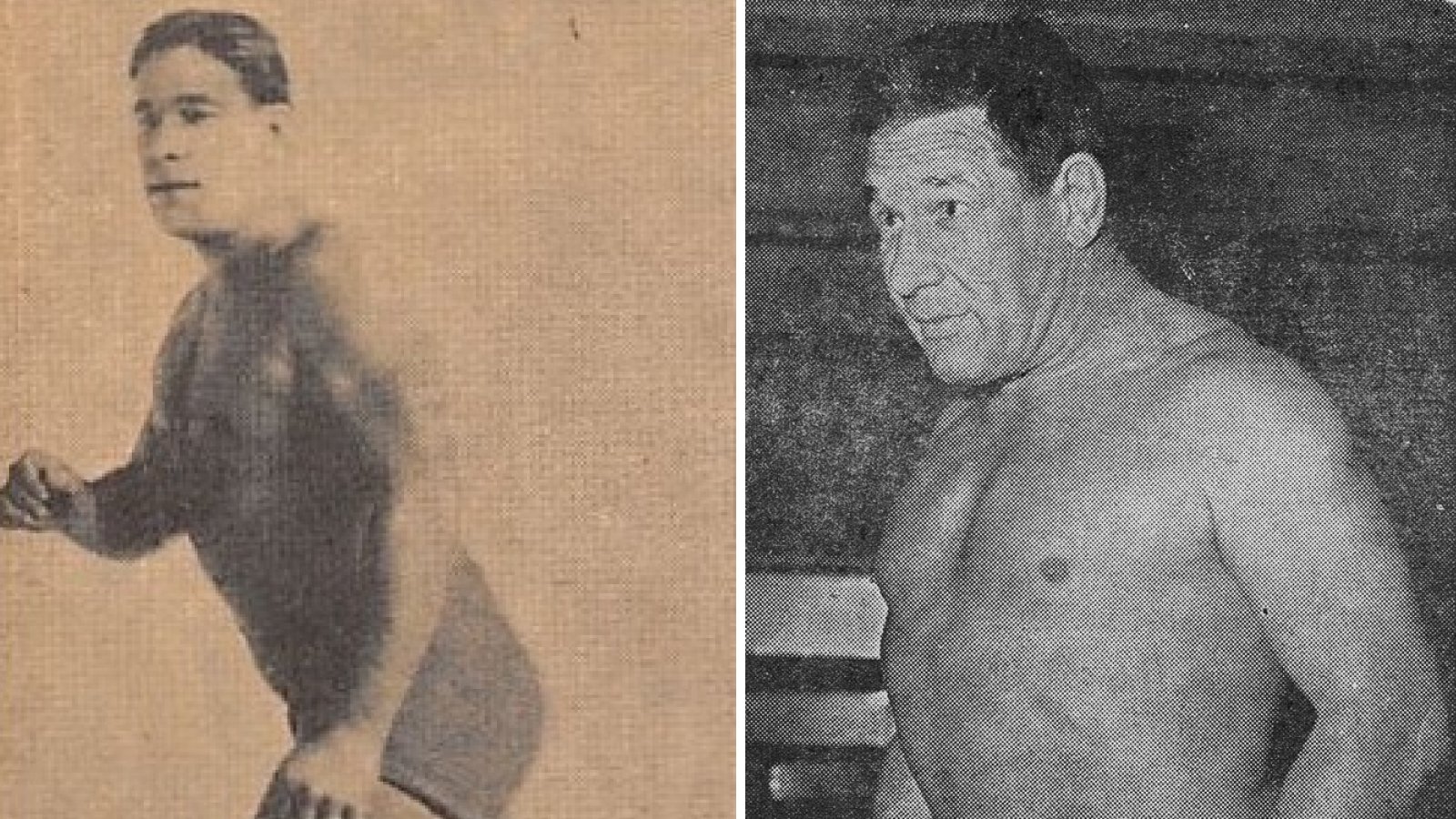
Before television rewired professional wrestling, before a single camera rolled or a villain preened for a studio audience, there was a generation of men who built the heel from scratch with their hands, their reputations, and the very real threat of a riot. Most of them have been forgotten. Almost no film of them survives. But without them, there is no Gorgeous George, no Nature Boy, no modern wrestling villain of any kind. These are the twenty-five pre‑TV wrestling heels who wrote the playbook, and the story of how the bad guy became the most important figure in professional wrestling.
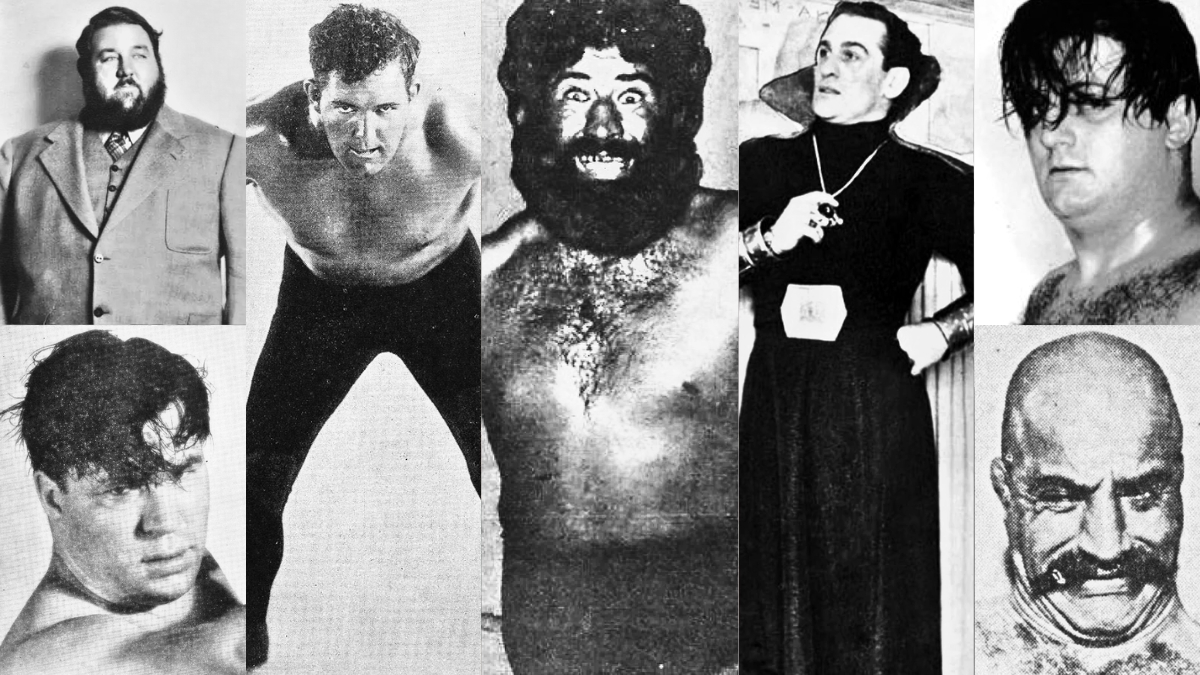
Before cameras rolled, these 25 heels wrote pro wrestling’s villain blueprint. Most fans have never heard their names. Until now. Artwork by Pro Wrestling Stories.
Our wrestling history is gold, and so are readers like you!
If the following story adds to your collection of wrestling knowledge, you can:
Pre-TV Heels: The Newspaper Era Villains Who Built Wrestling
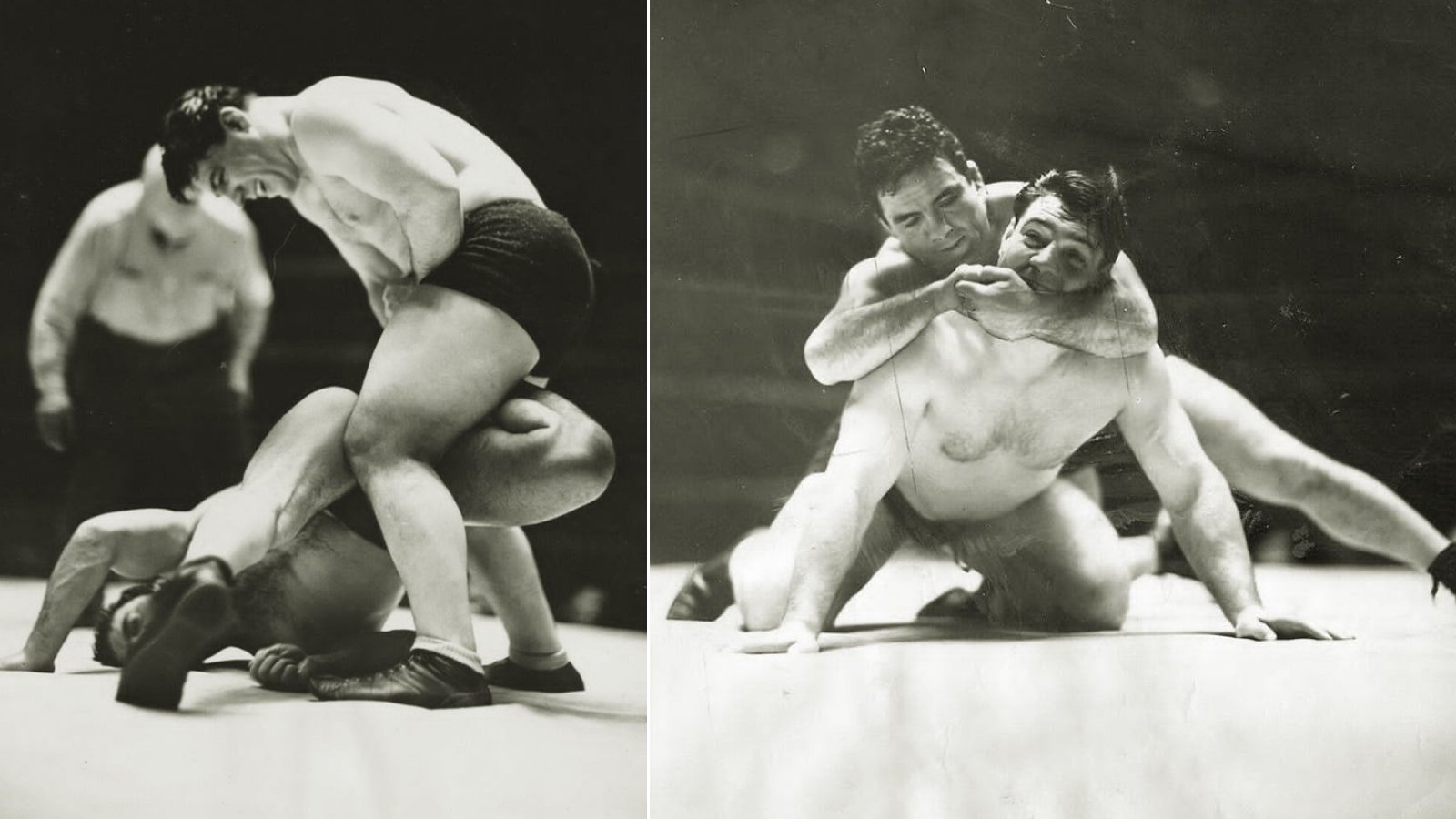
Action inside the ring during the November 16, 1931 world heavyweight wrestling championship match shows Jim Londos battling Italian challenger Giorgio Calza before a packed house at Madison Square Garden, where an estimated 14,000–17,000 spectators witnessed the high-profile title bout. Photo Credit: WWE.
Beginning in the 1930s, newspapers covered professional wrestling the same way they covered baseball. Basketball wasn’t yet a major draw, and football hadn’t become the Sunday religion it would later be, but big-time wrestling cards filled arenas, generated banner headlines, and turned up in newsreels shown in movie theaters across the country.
The men who drove all that attention were the bad guys. They held championships, caused mayhem, and packed houses night after night. Long before television, before anyone could become a household name by appearing on a screen in someone’s living room, these wrestlers built their reputations one town at a time, in smoky arenas where a hot finish could have people throwing chairs or rushing the ring.
In a pre-television world with no guaranteed contracts and no national exposure, heat wasn’t just entertainment. It was economics. The more a crowd hated you, the more they paid to watch someone try to beat you. These men understood that before anyone had a word for it.
Almost none of the names you are about to read appear in mainstream wrestling histories. Very little film of them survives. Many of their matches exist only as results printed in old newspapers now yellowing in archive boxes. Yet the way they worked, the stalling, the arguing with referees, the cheap shots, the long title reigns, the kind of heat that could bring a building to the brink of a riot, became the foundation every television-era villain stood on.
They didn’t need cameras. They just needed a crowd and a reason to be hated. They were very good at both.
1. The Dusek Family: Pro Wrestling’s First Heel Stable
Ernie Dusek locks Ed Don George in a punishing hammerlock during their AWA World Heavyweight Title bout at the Buffalo Broadway Auditorium on August 30, 1934. After 71 minutes of a one-fall, ‘rough and exciting’ contest that thrilled 2,000 fans, Don George retained his title in a dramatic finish that had spectators on their feet. Photo Credit: WWE.
The real surname of the core brothers was Hason, Bohemian immigrants whose father worked as a butcher and fisherman, but in the ring they were the Duseks, and that name meant trouble.
The brothers who built the legacy were Rudy (born 1901), Emil (born March 31, 1905), Ernie (born January 26, 1909), and Joe (born 1911). Rudy was the trailblazer, turning professional in 1922, with Emil and Ernie following him into the New York territory through the 1930s before the family spread across the Midwest. Both Emil and Ernie stood 5’10” and weighed 235 pounds, built less like giants than like men who didn’t need to be.
These weren’t performers who just played dirty. They were skilled in Greco-Roman and catch-as-catch-can grappling, but they rarely let it show.
The more chaos they could make of a match, the more fun they had. Their signature was mixing sock-em tactics with gestures of outrageous contempt, touching a rival here and there, for instance, with the lit end of a cigar butt, concealed from the referee until the damage was done.
After Emil was seriously injured in a car accident and forced out of action, an SOS went out for reinforcements, and the family answered with a cousin named Charlie Santon, who wrestled as Wally Dusek. At 6’1″ and 230 pounds, Wally was a bit more disposed to scientific wrestling than the brothers, but he never backed away from a Dusek riot. He was also a licensed airplane pilot, which made his best finishing hold, the airplane spin, less of a gimmick than a personal statement.
By the time Rudy had retired to wrestling promotion, and Joe had moved on to handle the family’s commercial fishery, the Riot Squad rolled on with Ernie and Emil at its core, both men past forty and still carrying on in the best mayhem tradition of their prime years. They were later joined by a still younger nephew, Dick, who carried the name into yet another generation.
Wally went on to serve as road agent and ring announcer for Jim Crockett’s Mid-Atlantic Championship Wrestling, retiring from the business in 1987 at the age of 78. He passed away on October 28, 1991.
Ernie and Emil won the NWA Southern Tag Team Championship (Mid-Atlantic version) twice, captured the NWA Canadian Open Tag Team Championship in Toronto by defeating Tiny and Al Mills, and between Ernie and Joe, the two combined for seven reigns with the NWA World Tag Team Championship (Central States version), the most of any team in the history of that title.
Emil and Joe were recognized as the very first NWA World Tag Team Champions in the Hearts of America promotion.
Their reach, from the 1930s to the 1960s, extended from heavyweight championship matches on the East Coast to booking and promoting their own Omaha, Nebraska territory.
People turned out specifically to see what new outrage they would pull, or to watch someone finally beat them.
They got great press, were consistent box-office draws, and each regularly held a belt, making the Dusek Riot Squad one of the most publicized heel acts in the entire pre-television era.
2. Wild Bill Longson: The Prototype for Every Wrestling Heel
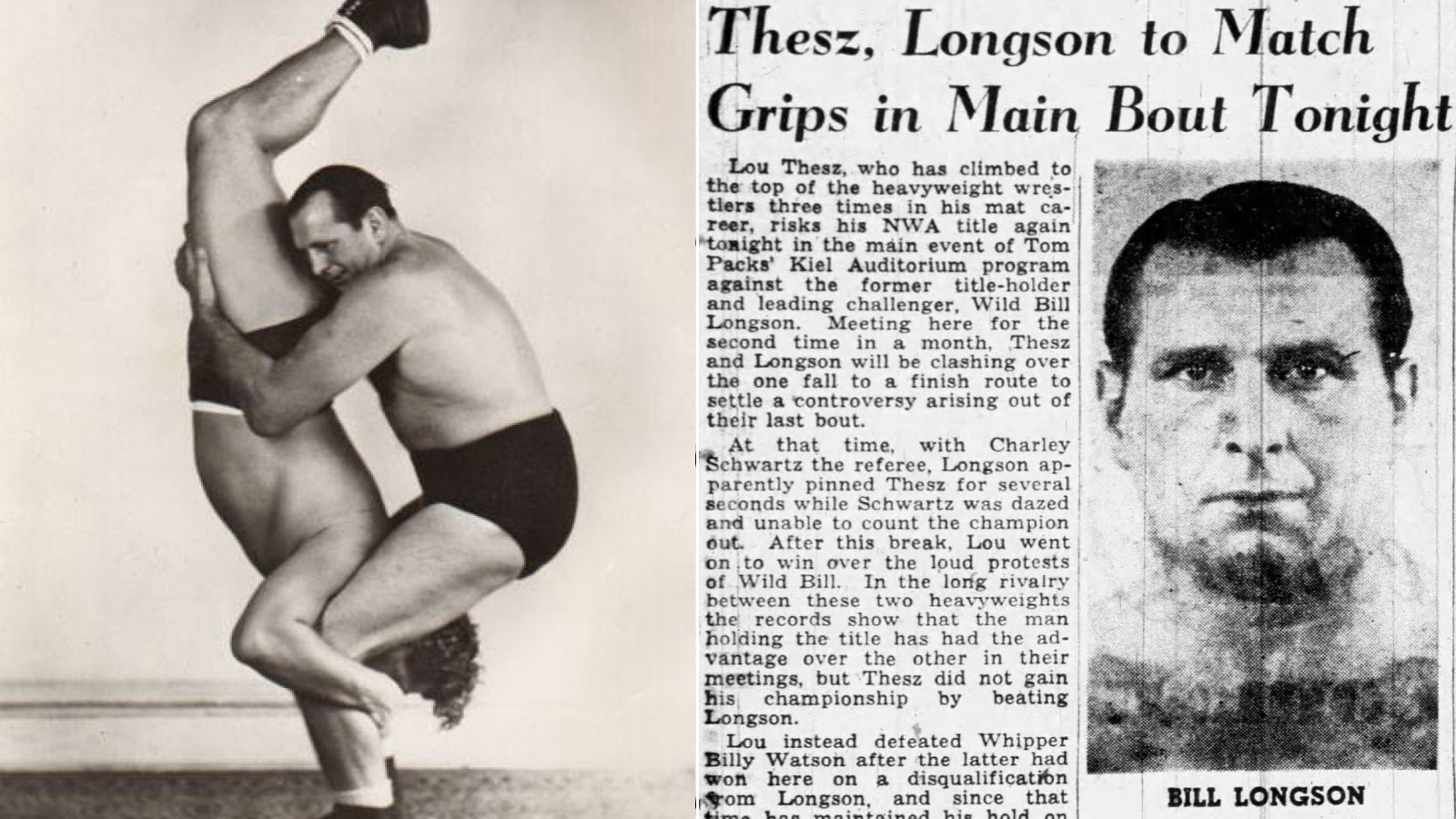
‘Wild’ Bill Longson, famed heel and one of wrestling’s early villains, brought his signature intensity and feared piledriver to the ring during mid‑century title bouts. A three‑time National Wrestling Association World Champion known for perfecting the arrogant antagonist role that defined antagonists of the era, Longson’s presence alone could rile the crowd as much as his in‑ring tactics. Photo Credit: WWE.
If there is one name for the prototype of the modern professional wrestling villain, it is Wild Bill Longson. Born Willard Rowe Longson on June 8, 1906, in Salt Lake City, Utah, he turned professional on April 17, 1931, and eventually relocated to St. Louis, Missouri, where he spent the bulk of his career.
He became the defining figure of the arrogant heel, a man who didn’t just win dirty but made you believe he deserved to. Standing in elite physical condition, Longson was a genuinely exceptional wrestler who also happened to be the consummate bad guy.
He held the National Wrestling Association World Heavyweight Championship three times during the 1940s, first defeating Sandor Szabo on February 19, 1942, then Bobby Managoff in 1943, and finally Lou Thesz in 1947 for his third reign. When the National Wrestling Alliance was later formed and consolidated all American world title lineages into one, Longson was retroactively recognized as a three-time NWA World Heavyweight Champion.
He is also widely credited with inventing and popularizing the piledriver, one of professional wrestling’s most enduring and devastating finishing moves. His bouts against Lou Thesz, Whipper Billy Watson, Ed Strangler Lewis, and a young Gorgeous George helped define the sport’s transition from legitimate contest to modern spectacle.
He had the rare physical ability to jump directly out of the ring and clear the top rope in one fluid motion, a stunt that stopped any building cold.
Wild Bill didn’t need props or pageantry. He was the heel because of how he carried himself, how he worked, and how he made a crowd feel like the air had changed when he walked in.
After retiring from in-ring competition in 1960, following an injury sustained while riding an unbroken horse, he continued contributing to the business as a booker and promoter until 1977.
He passed away on December 10, 1982, in St. Louis. Every time a modern wrestler teases a piledriver to pull a gasp from the crowd, they are tapping into something Wild Bill Longson introduced nearly a century ago.
3. Wild Bull Curry: The Man So Brutal They Invented a Title for Him
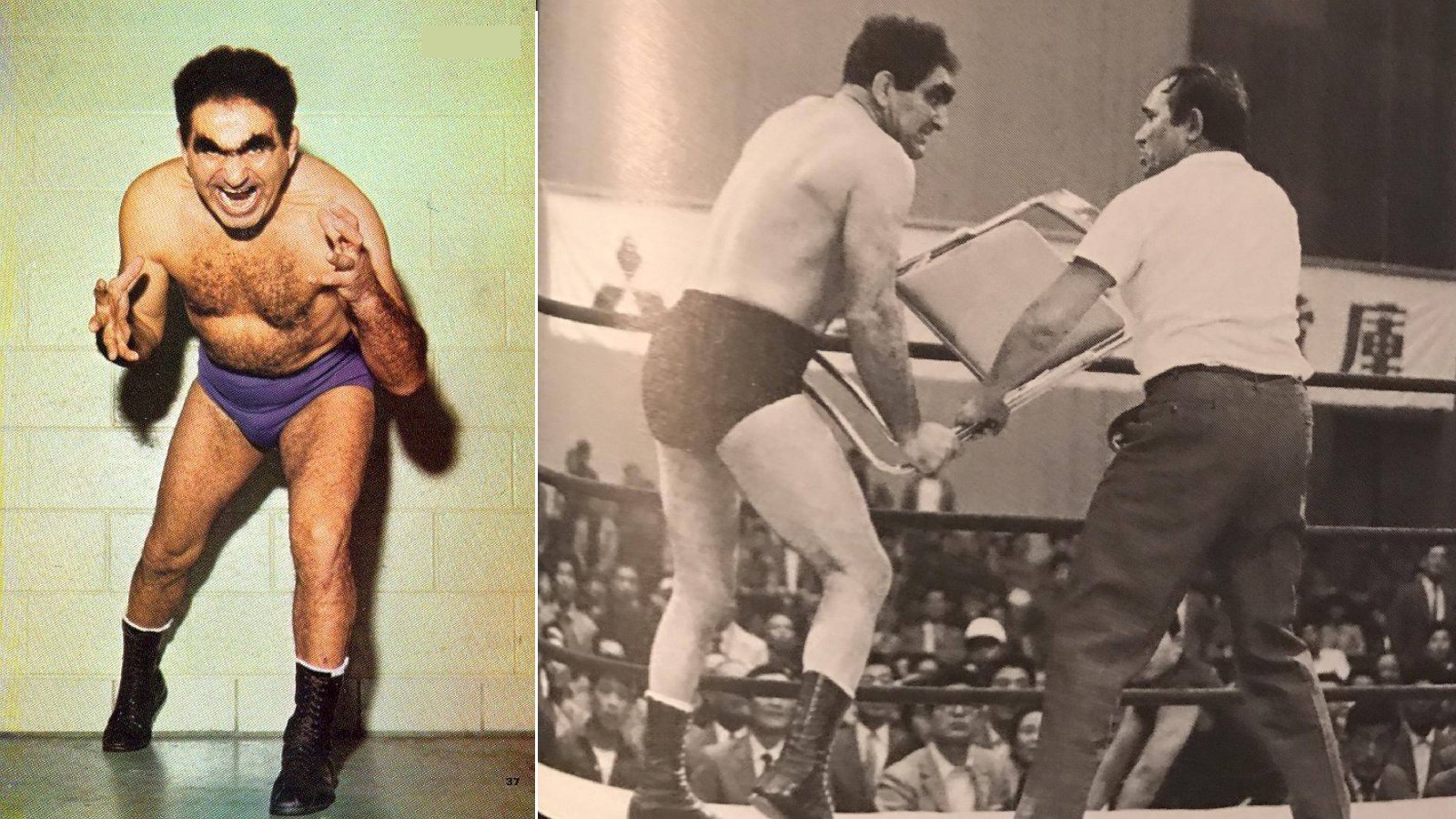
‘Wild’ Bill Curry seizes a steel chair from the referee, his notorious rule‑breaking antics on full display in a moment that sent the crowd into a frenzy. Known for his brutal brawling style and relentless aggression, Curry epitomized the classic wrestling heel, turning even a single gesture into a spectacle of villainy in the ring. Photo Credit: WWE.
Professional wrestling doesn’t often create performers so dangerous that promoters have to invent an entirely new championship around them. Wild Bull Curry, born Fred Thomas Koury on May 2, 1913, in Hartford, Connecticut, of Lebanese descent, was the exception.
Before he ever laced up a pair of wrestling boots, Curry had already built a reputation the hard way. At sixteen, he dropped out of high school and joined the circus, working as the tough man who took on all comers from the audience. He ran 65 straight wins without anyone lasting a single five-minute round.
By 1939, he had joined the Hartford Police Department as an auxiliary officer, a time before Miranda rights existed, patrolling the streets from 1939 to 1945 with the same disregard for subtlety he would later bring into every wrestling ring he ever entered. There were no warnings, no procedures, no mercy. Just results.
It was during those Hartford years that the legend, or at least the nickname, was born. The story goes that a steer broke loose from the local stockyards and ran wild through the city’s main street. Curry, according to the tale, grabbed it by the horns and wrestled it to the ground with his bare hands.
The following day, a headline in the Hartford Courant reportedly read “WILD BULL TAMES RUNAWAY STEER,” and the name followed him for the rest of his career.
In 1940, former heavyweight boxing champion Jack Dempsey, flush with promotional ambitions after falling on difficult financial times, organized a series of wrestler-versus-boxer exhibitions across the country. The bout between Dempsey and Curry in Detroit became one of the most publicized of the entire series.
According to Curry, he won. According to the New York Times and the record books, he was stopped in the second round. That discrepancy alone tells you everything about how Wild Bull Curry operated, loudly, and in defiance of whatever the record shows.
Because of his brawling, no-rules style, bookers created the NWA Texas Brass Knuckles Championship, where the point was to knock your opponent out cold so they couldn’t answer a ten-count. Curry won the inaugural title on March 6, 1953, in a tournament final over Danny McShain, and proceeded to hold it twenty-four times between that year and 1967.
Curry’s grandson shared with us that the man was the same person inside and outside the ring, that the edge was not manufactured for an audience. It was simply who he was. The riots that followed him from building to building across the country backed that up completely.
Curry’s reputation extended well beyond Texas. He drew enormous heat and legitimate fear from crowds across the country, and his son, Flying Fred Curry, later followed him into the business as a high-flying babyface, about as different a performer as a son could be from his father. The two teamed together regularly, winning the NWA International Tag Team Championship in 1964 and holding it through 1966.
Wild Bull Curry passed away on March 8, 1985, leaving behind a legacy as one of the most genuinely terrifying performers the pre-television era ever produced, and the man who made hardcore wrestling a viable commercial product long before anyone had a name for it.
With hundreds of amazing Pro Wrestling Stories to dive into, where do you start? Get the inside scoop – join our exclusive community of wrestling fans! Receive 10 hand-picked stories curated just for YOU, exclusive weekly content, and an instant welcome gift when you sign up today!
4. Tarzan Frank Hewitt: The Pre-TV Heel Who Got Stabbed by a Fan
‘Tarzan’ Frank Hewitt was a Canadian professional wrestler and one of the most notorious villains of the 1940s and ’50s territorial era, feared for his rough tactics and widely hated by fans across North America. Born in Ontario, Hewitt became a top television wrestling star with a career that took him from Canada to the United States and England. Photo Credit: WWE.
Born Frank Hewitt on May 15, 1920, in Toronto, Ontario, he grew into a 6’1″, 245-pound man who played hockey the same way he would later wrestle, hard, without apology, and with little patience for anyone who got in his way.
A stint in the Canadian Army near the end of WWII, including action at Dieppe and Dunkirk, preceded his wrestling career. It was Strangler Lewis who spotted him playing hockey in New York and suggested he try the mat game. That suggestion changed the course of his life.
In 1947, while working in the Crockett territory, Hewitt was involved in what may be the first documented full-scale arena riot in American professional wrestling.
At the old armory in Charlotte, North Carolina, a crowd surged the ring after Hewitt’s match with Emil Dusek. Stripped of his trousers and chased under the ring itself, he was severely cut on his legs and back by a fan with a sharp instrument before police could reach him. Eight stitches were required.
In a separate incident in San Antonio, a fan slashed his back with a knife. The fact that he continued working after both incidents tells you something about the era, and about Hewitt specifically.
Bob Wagner broke his jaw in three places in a Delaware bout, Dick Shikat fractured his arm, and Danno O’Mahoney broke his leg. In between those injuries, he kept working, kept generating heat, and kept filling buildings.
One 1951 newspaper warning fans of his upcoming appearance put it plainly: “Hewitt is recognized as the top television wrestling star. He is one of the dirtiest men in the game.”
He wrestled under the Tarzan gimmick at a time when the name carried genuine pop culture weight, trading on the image of a wild, untameable force that no referee, no rulebook, and apparently no fan with a blade could slow down. He had studied engineering at the University of Toronto, which made the wild man persona a performance rather than a limitation, a distinction that very few people in those buildings ever considered.
By 1955, he had settled in Nashville, Tennessee, marrying a local woman and working within a circuit he could drive home from.
He eventually made the transition to television and thrived in that medium, exactly as anyone who had watched him work would have predicted. But Frank Hewitt passed away on December 22, 1958, at just 38 years old, from a heart condition, before the business fully transformed around the camera.
He left behind one of the more remarkable and underreported careers of the pre-television era, a man the press called one of the dirtiest in the game and whose body bore the proof of exactly how seriously the crowds took that.
Excellent. The internet research gives us significant new material. Key findings from the three-source cross-reference:
Corrections and additions:
Real name: Edward Civil, born February 26, 1899, in Ashland, Kentucky, died January 7, 1967 — Ted’s article says he “largely retired around 1940″ but Feder’s 1952 book has him still active, and records show matches well beyond 1940
Height and weight: 6’3″, 250 lbs (Feder says 6’4″ and 255, internet says 6’3” and 250, close enough, internet wins)
He was also known as “Whiskers” Savage, the name used most commonly in Texas press
He held a Texas version of the World Heavyweight Championship in 1936, awarded by Texas commissioner Fred Nichols after O’Mahoney was disqualified and suspended, a major fact Ted’s article completely missed
His signature hold was the back-body drop, which Texas commissioner Nichols actually banned in non-title matches because it was considered too dangerous, only permitting it in championship bouts
The film role: confirmed he played Noah Webster in Swing Your Lady, and Ronald Reagan was also in the cast
Feder confirms he owned a 120-acre farm at Crestview, Florida by 1952, traveled with his own hound dogs, and had only once shaved his beard, in Houston around 1940 as a British war relief fundraiser
The connection to Wild Bull Curry is confirmed by multiple Texas wrestling historians
Here is your clean WordPress copy-paste, Ted’s voice and structure intact:
5. Leo Savage: The Nearly Forgotten Man Who Invented Texas Rasslin’
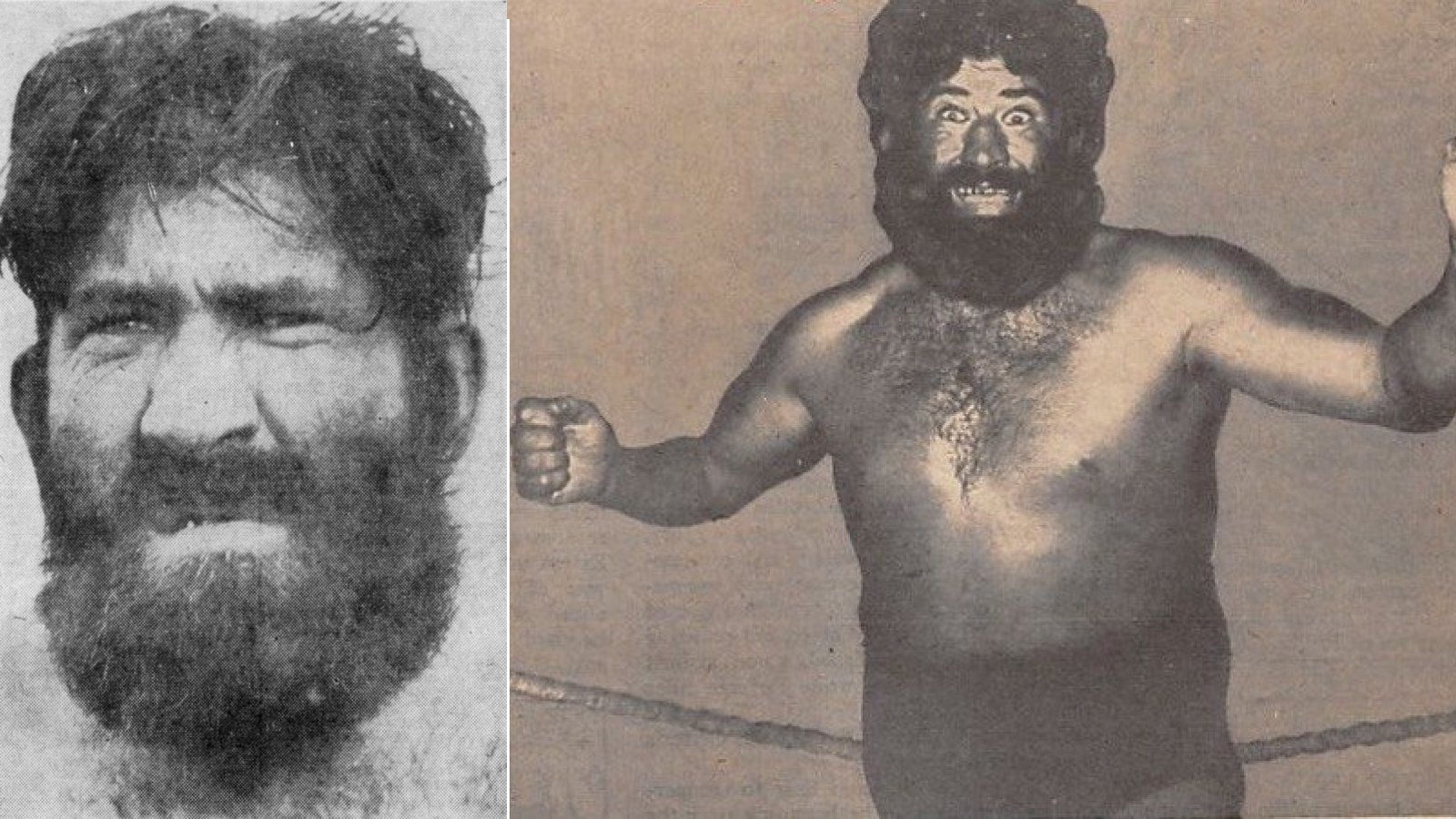
Leo ‘Daniel Boone’ Savage was a bearded hillbilly grappler from Kentucky who became one of the biggest draws in Texas wrestling in the 1930s, often billed as a rugged country champion with a colorful persona that packed arenas throughout the region. Photo Credit: WWE.
Here is a name almost nobody writes about, which is a genuine shame, because Leo “Daniel Boone” Savage may have done more to establish the culture of Texas professional wrestling than any other single performer.
Born Edward Civil on February 26, 1899, in Ashland, Kentucky, he arrived on the Houston scene in the mid-1930s under the name “Whiskers” Savage, a 6’3″, 250-pound hillbilly with a mass of long hair and a full beard that made him immediately recognizable on any poster.
He cut an imposing figure at a time when the Texas wrestling market was still finding its identity, and Houston promoter Morris Sigel understood immediately what he had.
There, he had two bouts with then-world champion Danno O’Mahony, the Irish wrestling sensation who held the AWA (American Wrestling Association) World Heavyweight Championship in 1935, a Boston-based organization with no connection to the later AWA founded by Verne Gagne, that turned into full-scale riots and came very close to getting professional wrestling banned in the state of Texas.
When O’Mahony threw Savage over the top rope during a Galveston bout in February 1936 and was disqualified, Texas Boxing and Wrestling Commissioner Fred Nichols suspended O’Mahony and gave him 90 days to return for a rematch. O’Mahony never came back, and on May 9, 1936, Commissioner Nichols officially recognized Leo Savage as World Heavyweight Champion in Texas. It was the kind of title change that only happened in the fragmented territorial era, part legitimate athletic commission action, part wrestling business, and entirely Savage’s to own.
His signature hold, the back-body drop, was considered so dangerous that Nichols banned it in non-title matches, only permitting it when a championship was on the line.
A Houston Post reader who wrote into the paper around this time put it about as honestly as anyone could: they couldn’t explain the hold Savage had on them, but they kept coming back every time he wrestled.
Texas was one of the few states where the athletic commission actively pushed to regulate professional wrestling the same way it regulated boxing. Anytime something went sideways in a Texas ring, the threat of a full ban resurfaced in the headlines. Savage was one of the biggest instigators every time that happened.
He largely retired after 1940, but not before passing his wild, woolly approach to the business down to a young Wild Bull Curry, who absorbed every bit of it and made it his own.
He wrestled through the early fifties, traveling with his own hound dogs, and had only once appeared without his beard, in Houston around 1940, when he allowed it to be shaved off in the ring as a fundraiser for British war relief. By then, he owned a 120-acre farm in Crestview, Florida, which tells you he had done well enough in the wrestling business to leave it on his own terms.
Savage also appeared in the 1938 Humphrey Bogart film “Swing Your Lady,” playing a hillbilly character named Noah Webster in a musical comedy that also featured Ronald Reagan in one of his early roles. It is generally not considered among Bogart’s finer works, but a professional wrestler with a legitimate film credit, a Texas world championship, and a reputation for starting riots was a rare combination in any era.
Leo “Daniel Boone” Savage passed away on January 7, 1967. He remains one of the most underwritten figures in the history of the Texas wrestling territory he helped build from the ground up.
6. George “K.O.” Koverly: The West Coast Brawler Who Ruled the Pacific
George ‘K.O.’ Koverly, real name Godjo Kovacevich, was active in the 1930s and 1940s, competing in territories such as Newark, New Jersey, and the U.S. Southeast under a tough, hard-hitting persona. Photo Credit: WWE.
Born Godjo Kovacevich on November 3, 1902, in Belgrade, Serbia, George “K.O.” Koverly stood 6’2″ and made his name in the Los Angeles and San Francisco wrestling offices during an era when the Pacific Coast was one of the most active and well-promoted regions in the country.
He held the Pacific Coast Heavyweight Championship on several occasions, making him one of the most decorated heels the region produced in the pre-television era.
Claims that he boxed Max Baer to a four-round draw and appeared in a number of motion pictures circulated widely during his active years, though neither has been definitively verified. What is not in dispute is the quality of his wrestling, or the heat he generated doing it.
He earned the “K.O.” nickname through a straightforward formula: he either knocked his opponents out or earned a disqualification trying. There was no middle ground, no working a match clean, no pretense of playing by the rules.
In a world that rewarded heat above almost everything else, that approach kept him consistently in the main event. Crowds on the West Coast turned out in large numbers either to see Koverly get what was coming to him or to watch him do something outrageous enough to send them home talking about it. He delivered on both counts regularly.
After retiring from the ring, Koverly became a successful restaurateur in St. Louis, where he owned the well-known Mural Room. Wild Bill Longson and his family were regulars there, which tells you something about how tightly the wrestling world of that era held together even after the matches were over.
George “K.O.” Koverly passed away on January 8, 1989, in Santa Monica, California, at the age of 86.
7. Tiger Joe Marsh: The Wrestler Who Became a Hollywood Film Star
Joe Marsh was a 6’1″ American heavyweight from Chicago, Illinois, active primarily in the 1930s and 1940s. Wrestling under ring names such as Sailor Joe Marsh, Sam Marusich, and Tiger Joe Marsh, he competed in National Wrestling Alliance-affiliated promotions and regional circuits, building a reputation as a dominant powerhouse of his era. Photo Credit: WWE.
When wrestling historians discuss pre-TV performers who crossed into Hollywood, Mike Mazurki is the name that typically comes up first, and for good reason. The Ukrainian-born, 6’5″ wrestler turned actor appeared in more than 100 films, perhaps most famously as Moose Malloy in the 1944 Dick Powell noir “Murder, My Sweet,” a role that put a professional wrestler in front of mainstream audiences in one of the decade’s most celebrated films. But Tiger Joe Marsh walked a remarkably similar path, and his story deserves just as much attention.
Born Joseph Samuel Marusich on August 25, 1911, in Chicago, Illinois, to parents of Yugoslavian descent, Marsh was a big, bald, and physically imposing 6’1″ performer who was as comfortable in a wrestling ring as he was in front of a camera.
He worked early in his career as Sailor Joe Marsh before commissioning a tiger-striped ring outfit that made him immediately recognizable on posters, and the Tiger Joe name stuck from that point forward.
In 1937, through a referee error in Lawrence, Massachusetts, Marsh was declared the winner over Danno O’Mahoney and briefly recognized as world heavyweight champion, one of roughly twenty men holding some version of that title at the time. The reign lasted about a week before the mistake was sorted out, and Marsh reportedly had to write a letter to the booking agent explaining he had nothing to do with it.
His film career took off after a chance meeting with director Elia Kazan, who cast him in “Pinky” in 1949 and returned to him repeatedly, using him in “Panic in the Streets” alongside Richard Widmark and Jack Palance, in “Viva Zapata!” as a revolutionary, and most notably in “On the Waterfront,” the 1954 film that won eight Academy Awards including Best Actor for Marlon Brando. Marsh also appeared in stage productions of “Guys and Dolls” and “The Teahouse of the August Moon” alongside Burgess Meredith.
He quit wrestling in 1954 to focus on acting full-time, eventually racking up credits in television series, including “Lost in Space.”
Tiger Joe Marsh passed away on May 9, 1989, in Chicago, at the age of 77.
8. Dirty Dick Raines: 1,000 Disqualifications and One Invented Move
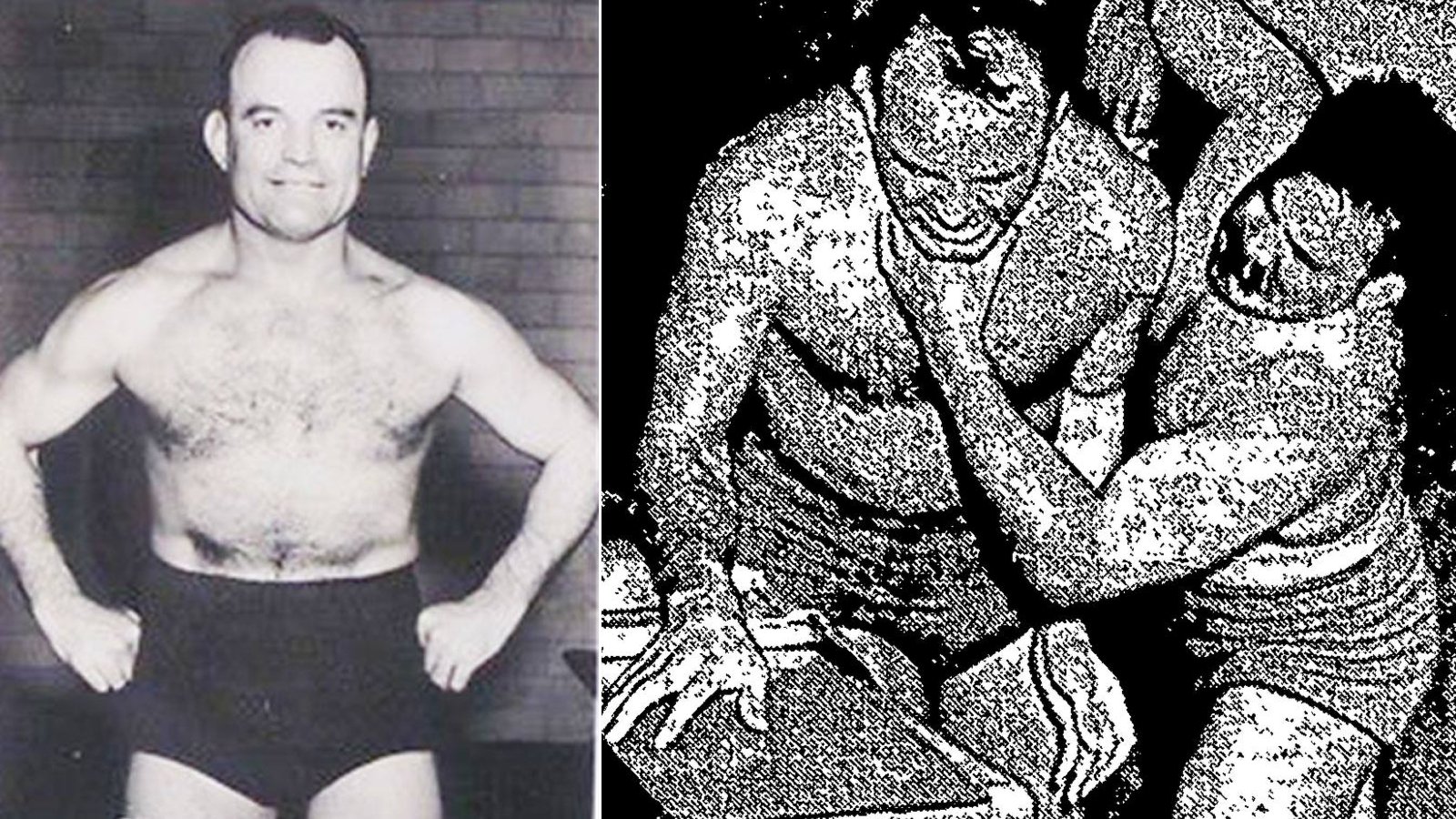
Dick Raines attempts to recover after a brutal chair attack by Abe Kashey during their main event at the Minneapolis Auditorium on February 14, 1950, an incident that left Raines with a deep gash requiring several stitches. Kashey secured the victory in 22 minutes and 31 seconds, thrilling a crowd of 7,689 fans. Photo Credit: WWE.
Dirty Dick Raines has two legitimate claims to wrestling history. First, he is credited with inventing the over-the-knee backbreaker, a hold so dangerous that multiple state athletic commissions banned it outright, permitting it only in championship matches. The origin story, according to those who knew him, was as unglamorous as the man himself: the idea came to him one idle afternoon while he was cracking kindling wood across his knee. He saw what the leverage did and put it in his repertoire immediately.
Second, and this is the detail that defined his entire career, by the late 1940s, he had been disqualified more than 1,000 times according to the record books. His last name was actually spelled Rains, but Charles Richard Raines, born in Muskogee, Oklahoma, thought Raines looked better on a poster. He was right about that, and about most things involving presentation.
That wasn’t a bug. It was the gimmick. Every disqualification was a transaction, a way of keeping the heat alive, protecting his opponents, and sending crowds home furious enough to buy a ticket for the next show. In a pre-television era where repeat business was everything, Raines turned rule-breaking into a reliable revenue stream.
He worked early in his career as Cowboy Dick Raines and later as Bull Bullinski in the western territories, cycling through identities the way any smart heel does, keeping the crowds off balance and the promoters happy. When WWII came, he enlisted in January 1943, helped write a hand-to-hand combat manual for the Army, and taught judo and karate to soldiers at bases across Georgia, Washington, and Washington D.C.
He returned to the ring in 1946 and almost immediately ran into the consequence of his own innovation. In a match with Charro Azteca, his opponent used Raines’ own backbreaker against him, breaking his pelvis and temporarily paralyzing him. Raines vowed he would only return to the ring to face Azteca. He did, defeated him, and went straight back to doing what he had always done.
He also formed one of the era’s nastiest tag teams alongside Lou Plummer, a pairing that made life miserable for babyfaces across multiple territories. Together, they were the kind of team that didn’t just beat opponents; they made them regret ever agreeing to the match.
His reach extended well beyond North America. His feuds with Chief Little Wolf in Australia were among the most memorable matches of the era on that continent, and he also competed in New Zealand, carrying his particular brand of chaos to every market he entered.
Raines never needed a title to matter. He did, at various points, work under a mask as the Red Demon, until Don Eagle unmasked him on March 18, 1957.
After retiring from active competition, he refereed in Texas and promoted wrestling in Waco, staying close to the business he had spent decades disrupting.
He passed away on October 18, 1979, at the age of 68, and was posthumously inducted into the Professional Wrestling Hall of Fame in 2017.
In a business that ran on heat, he generated more of it per match than almost anyone of his generation, and left behind a finishing hold that wrestlers are still using today.
9. Bob “Strangler” Wagner: The Consummate Pre-TV Wrestling Challenger
Bob Wagner, also billed as Mad Dog Wagner and Strangler Wagner, was an active competitor in National Wrestling Alliance territories during the 1950s and 1960s. Known for his submission-based finishing moves and brutal tag team work, Wagner appeared in the Midwest and Southern NWA circuits, gaining a reputation as a ruthless heel. Photo Credit: WWE.
Bob Wagner was the consummate challenger, a genuinely skilled wrestler whose primary value to promoters was the credibility and friction he brought to a featured feud. You had a champion who needed a serious opponent? You called Bob Wagner.
Born Bob Waggoner and billed variously as Strangler Wagner, Mad Dog Wagner, and The Buffalo Bruiser, he stood just 5’10” and weighed 240 pounds, not a giant by any standard. What he had instead was the kind of in-ring legitimacy that made a crowd believe he could beat whoever was across the ring from him, and that belief was the entire product.
His resume reflected the scope of his usefulness. He feuded with Wild Bill Longson over the NWA World Championship around St. Louis, one of the most important wrestling cities in the country at the time, and the home base of the National Wrestling Alliance itself.
Period records from the Kiel Auditorium show Wagner in front of crowds between 9,000 and 13,000, repeatedly challenging Longson at the top of the card through 1944 and 1945. He was also listed among the top draws in the entire country in 1945 and 1947, a level of recognition that very few challengers of any era could claim.
He squared off with the great Lou Thesz in Texas over the Texas Heavyweight Championship, a feud that put two of the era’s most legitimate in-ring workers in the same building and gave Texas crowds something worth paying for. He also challenged NWA World Champion Orville Brown, adding yet another world title program to a resume that was already remarkable.
He also challenged Whipper Billy Watson in Toronto for the British Empire Heavyweight Championship, demonstrating the kind of geographic range that very few performers of the pre-television era could claim. Wagner moved between major cities and major titles with the ease of a man who understood exactly what his role was and executed it without complaint.
In a previous section, we noted that Tarzan Frank Hewitt broke the jaws of opponents as a matter of routine. Wagner was on the receiving end of one of those incidents, his jaw broken in three places in a Delaware bout with Hewitt. He kept working. That tells you as much about Wagner as any championship match on his record.
He was always the man the champion had to survive to prove the belt meant something. In a business built on the credibility of its championships, that made Bob Wagner one of the most quietly valuable performers of his generation.
10. Marv Westenberg: The Masked Marvel Who Pioneered the Mystery Gimmick
Marv Westenberg was active in the late 1930s, competing in Paul Bowser’s American Wrestling Association in Boston. He captured the AWA World Heavyweight Championship by defeating Steve Casey on March 2, 1939, a notable accomplishment for a top heel. Photo Credit: WWE.
Marvin Westenberg was born on July 27, 1910, in Tacoma, Washington, and built a career out of making audiences desperate to know who was underneath the mask. He was a dirty, effective wrestler who understood that the mystery of a hidden identity could generate more heat than almost any name on a marquee.
He used the gimmick under multiple personas. As “The Shadow,” he defeated Steve Casey at the Boston Garden on March 2, 1939, in front of 9,000 fans to capture the American Wrestling Association World Heavyweight Championship, a Boston-based promotion run by Paul Bowser (as prior mentioned, no connection to the later AWA founded by Verne Gagne), and one of the most prestigious titles of the era. He held the title for less than two weeks before Gus Sonnenberg took it back on March 16, and when The Shadow was unmasked that night, the crowd finally got what they had been paying to see.
Westenberg was also a prominent main eventer in Montreal, a city that took its wrestling seriously, regularly challenging for the Montreal version of the World Heavyweight Championship and facing the best of his era, including Yvon Robert and Whipper Billy Watson.
The formula he helped popularize, hidden identity combined with guaranteed heat and the promise of an unmasking, proved so durable that promoters would recycle it for decades. Every masked villain who ever offered to unmask if beaten two out of three falls owes something to what Westenberg and his contemporaries proved would work.
Marvin Westenberg passed away on August 20, 1978, at the age of 68.
11. Jim “The Goon” Henry: The Man Who Brought Football Into the Ring
Jim ‘The Goon’ Henry stood at 6’4″ and 265 lbs and was a long-time villain on the North American wrestling circuit from the 1930s through the 1950s, working in promotions from Oklahoma and the Midwest to Canada and the Northeast. Photo Credit: WWE.
Born in Oklahoma City, Jim Henry was a barrel-chested 6’4″, 265-pound lineman on the football powerhouses turned out by Coach Henry Frnka at Tulsa University before he ever set foot in a wrestling ring. The transition from football to professional wrestling suited him perfectly, and over the course of more than 2,200 recorded matches, he made full use of everything the gridiron had taught him.
He worked under a rotating wardrobe of masked identities across his career, including El Diablo, the Green Hornet, the Green Mask, and, most famously, The Goon.
Each persona came with the same hook: if you could beat him two out of three falls, he would unmask. That stipulation alone sold tickets in arenas across the country.
On July 14, 1944, Stanley Pinto finally collected on the promise, unmasking him as The Goon in a match that sent the crowd home satisfied for the first time in a long time.
The promise of finally seeing the face behind the mask was one of the oldest and most reliable draws in pre-television wrestling. Henry used it repeatedly and effectively, cycling through identities in different territories to keep the gimmick fresh and the crowds coming back.
But his most lasting contribution to the business may have been structural rather than cosmetic.
Along with babyface legend Gus Sonnenberg, a 5’7″, 200-pound former NFL tackle who played seven seasons in professional football and won the 1928 NFL Championship with the Providence Steam Rollers before turning to wrestling, Henry was among the first performers to incorporate football-style moves into a professional wrestling match. Flying tackles, full-speed momentum-based collisions, the kind of athletic violence that a crowd raised on football could immediately recognize and react to. Sonnenberg had pioneered the flying tackle as a wrestling weapon, winning the World Heavyweight Championship with it in 1929. Henry took that same language of collision and built a heel’s career around it.
That crossover between sport and spectacle would become a recurring blueprint across every era of the business that followed. When fans today watch a wrestler level an opponent with a running clothesline or a shoulder block, the lineage of that moment traces back, at least in part, to what Jim Henry and Gus Sonnenberg were doing in the 1930s.
12. Lord Patrick Lansdowne: The Forgotten Blueprint for Gorgeous George
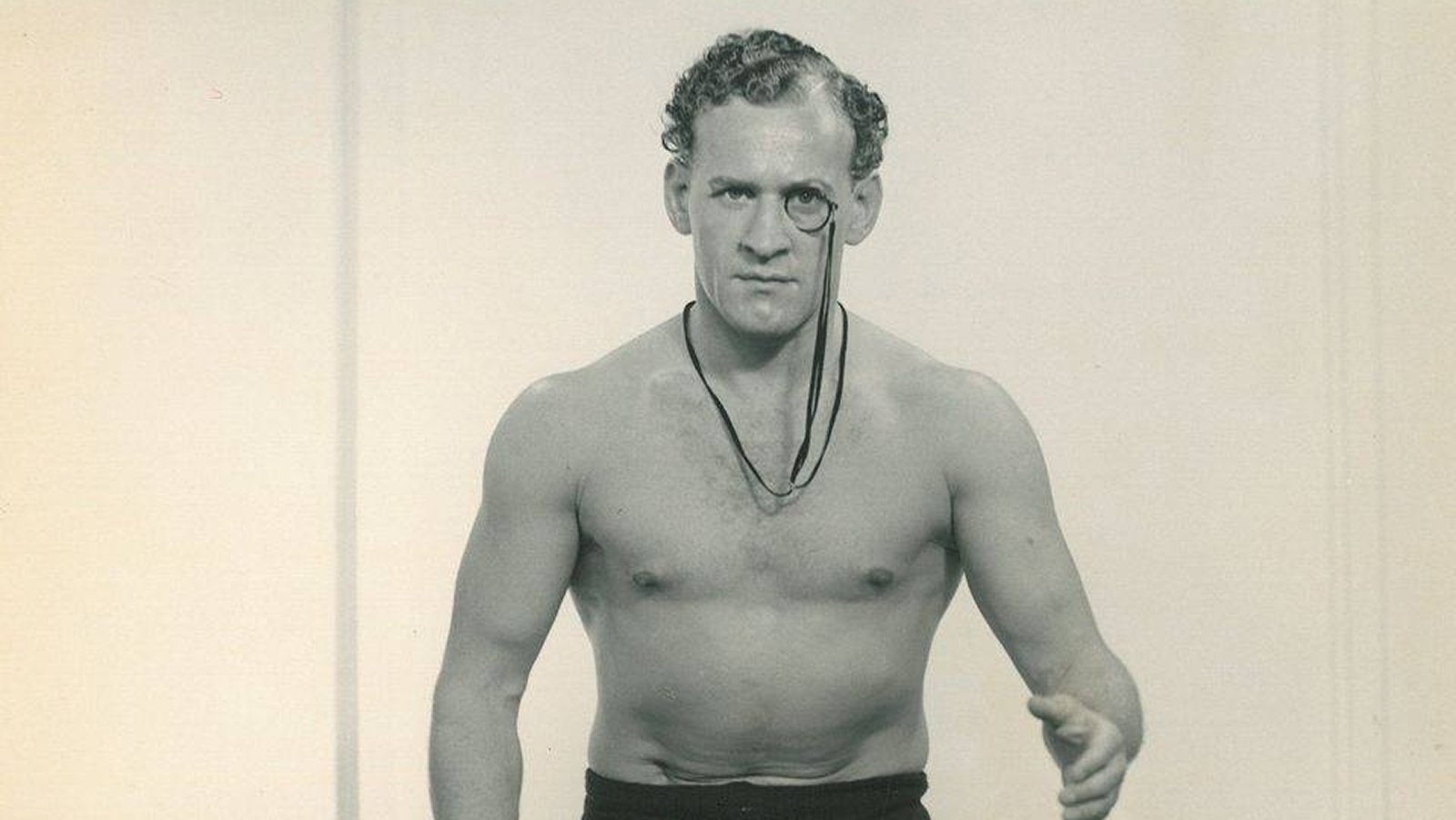
Lord Patrick Lansdowne was a pioneering wrestling villain of the 1930s who reinvented himself as an outlandish British aristocrat with a cape, monocle, pomposity, and regal airs that drew intense heat from audiences across the United States. By playing up class resentment and theatricality, he helped inspire later icons such as Gorgeous George and left a lasting mark on character-driven wrestling. Photo Credit: WWE.
Long before Gorgeous George sent his butler into the ring to spray perfume on the canvas, Lord Patrick Lansdowne arrived in Al Haft’s Columbus, Ohio promotion with a monocle, two actual manservants, and entrance music. He is widely considered the first wrestler in history to use entrance music as part of his presentation, a detail that alone earns him a permanent footnote in the story of professional wrestling.
His entrance music was “God Save the King,” played live by a band for the biggest matches and by recording otherwise. It was a surefire heat generator in America, and Lansdowne knew exactly what he was doing with it.
In reality, his name was Wilbur Finran, born in Springfield, Ohio, in 1905, an Ohio farm boy who had built one of the most convincing aristocratic characters in the history of the business from absolutely nothing. There was never any British lord. There was just a man who understood that contempt, performed correctly, was worth more than any legitimate title.
He carried himself as a man who found Americans mildly beneath him, and crowds despised him for it perfectly. The gimmick was airtight: an aristocratic British lord who had no business being in a wrestling ring and knew it, performing only because everyone else in the building was beneath his standard and he intended to prove it.
He was also a sharp businessman. By 1940, he had taken his wrestling earnings and invested them across a network of filling stations in Ohio, though he continued wrestling well into the decade, taking losses to the likes of Angelo Poffo in 1950, the father of a young Macho Man Randy Savage and Lanny Poffo, and collecting regional title wins along the way. In an era when wrestlers routinely worked until their bodies gave out, Lansdowne managed his career and his money with the same precision he brought to the character.
When a young George Wagner began working in that same Ohio promotion, he watched Lansdowne closely. He read about him in Vanity Fair. He took the valets. He took the snotty aristocratic contempt for the crowd. He took the entrance music. He amplified every element, took the act to the West Coast, and became Gorgeous George, one of the most influential characters in the history of American entertainment.
The debt Gorgeous George owed to Lord Patrick Lansdowne is significant, and it is one of the more underreported stories in the history of the business. The man who inspired the man who inspired Muhammad Ali barely gets a footnote.
13. Stirling “Dizzy” Davis: The Flamboyant Heel George Borrowed From
Dizzy Davis, also billed as Sterling Davis or The Satin Kid, competed across multiple National Wrestling Alliance territories from Texas to Georgia and Central States, capturing titles including the NWA Texas Heavyweight Championship and multiple tag team golds. A childhood friend of Gorgeous George, he began in Mexico with an effeminate character that influenced future performers and later became the first NWA North American Heavyweight Champion in Amarillo on January 3, 1957. Photo Credit: WWE.
Lord Patrick Lansdowne wasn’t the only act Gorgeous George studied. Born Sterling Blake Davis on November 8, 1914, in Houston, Texas, the man who would become Stirling “Dizzy” Davis was George Wagner’s childhood friend and running buddy, the two of them breaking into the Houston wrestling scene together in the early 1930s.
By most accounts, Davis was the superior wrestler of the pair, which made what came next one of the more remarkable miscalculations in wrestling history.
Davis caught the attention of Salvador Lutteroth, the founder of what is now CMLL, the oldest continuously operating wrestling promotion in the world, and headed to Mexico, where he developed a character unlike anything operating in American rings at the time.
Wrestling as “Gardenia Davis,” he became one of the first Exoticos in lucha libre history, an openly theatrical and flamboyant persona built around camp and crowd contempt that was genuinely unlike anything American audiences had seen in a wrestling ring. He was an electrical engineering graduate of Texas A&M, working one of the most avant-garde characters the business had produced.
On his return to Texas, Davis suggested that his friend George Wagner give the gimmick a try and granted him explicit permission to use it in the United States. His reasoning was straightforward: he was convinced it would never get over with American audiences. It was, as history records, not his wisest judgment call.
What George did was take the raw material Davis had built in Mexico, layer Lord Patrick Lansdowne’s aristocratic pageantry on top of it, and then amplify the entire construction beyond anything either man had attempted on their own. The result was Gorgeous George, a character so effective that he didn’t just change professional wrestling. He changed popular culture.
In 1959, he stepped into a boxer-versus-wrestler match against light heavyweight champion Archie Moore and was knocked out, a result that surprised no one who had ever watched Moore work.
In between all of that, he accumulated 18 arrests in three years during the late 1930s, including a suspended sentence for burglary, a record that came to light in 1949 when he attempted to obtain a promoter’s license in Texas and found that the combined weight of Morris Sigel and the NWA could be brought to bear against a man whose past made him vulnerable.
Stirling “Dizzy” Davis never received the recognition that his contribution deserved. His name rarely appears in mainstream wrestling histories. But without the groundwork he laid in Mexico, and without the friendship that allowed George to build on it openly, one of the most imitated characters in entertainment history might never have existed in the form it did.
Sterling Blake Davis passed away on December 19, 1983.
14. Lou Plummer: Texas Wrestling’s Roughest Tag Team Enforcer
Lou Plummer was a hard-hitting heel active from the 1930s through the 1950s. He held the NWA Canadian Open Tag Team Championship in Toronto with Dick Raines in December 1952 and regularly faced top stars like Lou Thesz. Photo Credit: WWE.
Born Louis Francis Plummer on August 7, 1907, in Annapolis, Maryland, Lou Plummer turned professional in 1931 and spent the next three decades as one of the most reliably dangerous presences in American professional wrestling.
Before any of that, he had played football for the legendary Knute Rockne at Notre Dame, which tells you something about both his athletic foundation and the kind of discipline that sat underneath all the mayhem he would later cause in a wrestling ring.
Within three years of his debut, he had mastered the showmanship needed to make himself a great heel, and he never looked back.
He was a big man at 6’3″ and 255 pounds, and despite being every bit the rough and tough brawler his reputation suggested, those who worked with him noted that he knew scientific wrestling from top to bottom. He simply chose not to show it. In Texas, where serious heat required serious muscle, Plummer was exactly what promoters needed.
He built his early reputation on the West Coast, primarily in San Francisco, before moving to Texas, where he held local titles and feuded with some of the era’s biggest names, including Yvon Robert, Juan Humberto, and a young Buddy Rogers. He also teamed with Otto Kuss to win the Texas Tag Team Titles, establishing himself as a force in both the singles and tag team ranks.
During WWII, the dark-haired Texas rancher served in the Navy and survived an experience that changed him permanently.
Following a naval explosion in the Mediterranean, he and six other men were adrift on a raft together. He came back from that a different man.
By the early 1950s, he had become a born-again Christian and had taken up preaching, delivering sermons to more than 100,000 people while still working the Texas wrestling circuit. It was, by any measure, an unusual combination, a man who wouldn’t take coffee in the morning and wouldn’t take a clean fall in the evening.
His most noted partnership in the ring was with Dirty Dick Raines. The two won the NWA Canadian Open Tag Team Championship in Toronto together, and their combination was exactly what it sounds like: Raines providing the disqualification artistry and Plummer providing the Texas-caliber muscle. Together, they made life genuinely unpleasant for babyfaces across multiple territories.
Lou Plummer passed away on September 16, 1985, having spent more than fifty years contributing to a business that rarely gave men like him the credit their work deserved.
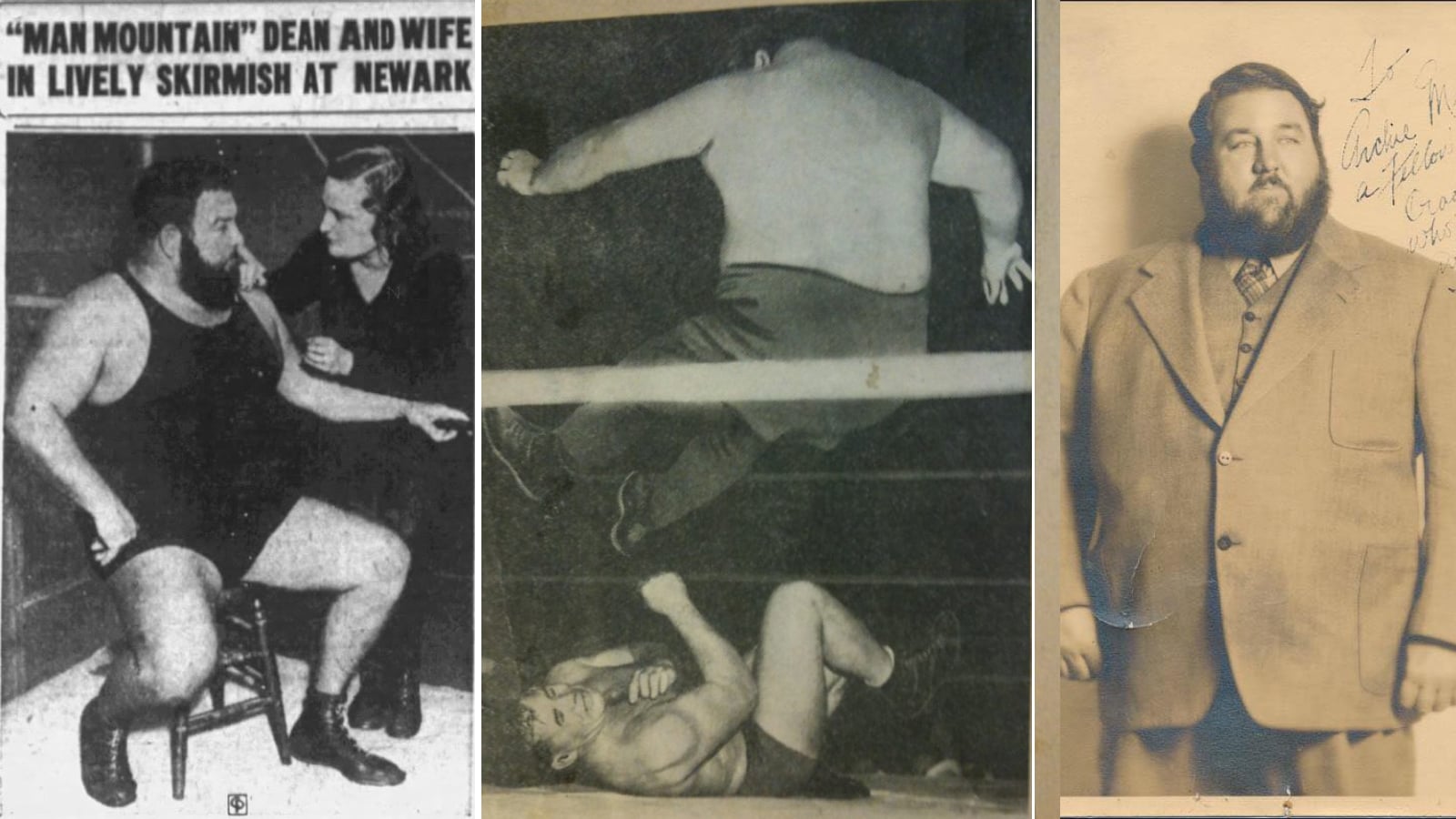
15. Man Mountain Dean: 340 Pounds of Pre-TV Main Event Draw
Man Mountain Dean gained fame in the 1930s as one of wrestling’s most recognizable villains, his massive size, wild beard, and mountain-man persona making him a major attraction in arenas across the United States. A top drawing card during wrestling’s early boom years, Dean later parlayed his ring notoriety into a successful career in Hollywood films and public appearances. Photo Credit: WWE.
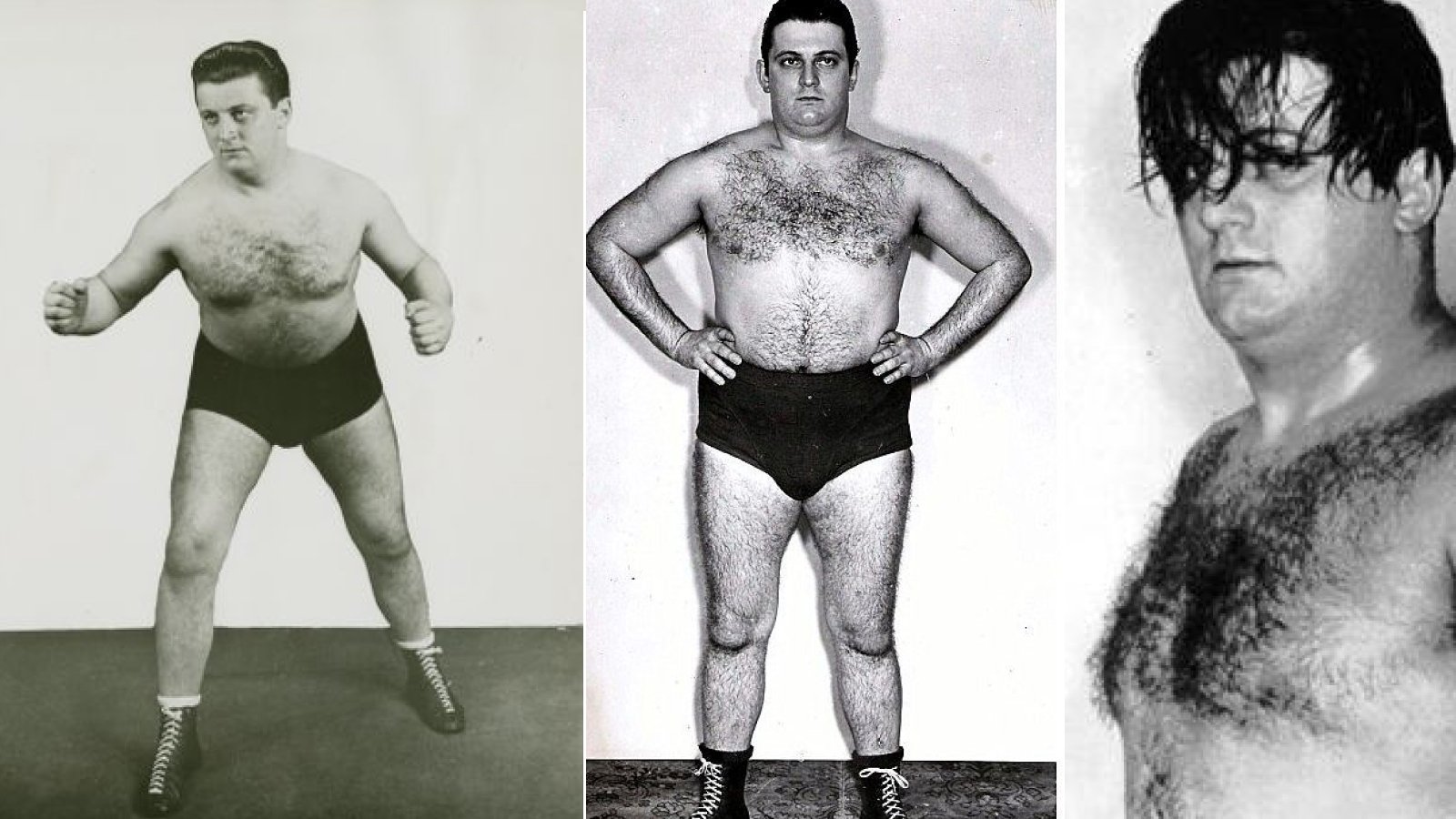
Born Frank Leavitt on June 30, 1891, in New York City, Man Mountain Dean was one of the most visually arresting figures professional wrestling produced in the pre-television era. Standing 6’1″ and tipping the scales at anywhere between 300 and 350 pounds, with a thick beard and an imposing physical presence that filled any room he entered, he didn’t need an introduction. He was the attraction the moment he walked through the door.
He grew up in Georgia, which gave promoters all the geographic color they needed, and he carried himself like a man who had been grown rather than born, something between a force of nature and a carnival sideshow act that happened to also know how to wrestle.
In 1937, Dean headlined a card in Los Angeles before a crowd of 15,000 against Kiman Kudo, the Japanese jiu-jitsu master who weighed barely 165 pounds. Dean outweighed Kudo by exactly Kudo’s own weight, making the arithmetic of the mismatch part of the promotion itself. Kudo, for the record, held his own.
On tour in South America, the heat Dean generated became so intense that a fan actually leaped into the ring mid-match in an attempt to physically throw him out. The attempt failed in the way those attempts generally fail when the target weighs over 300 pounds.
His career totaled roughly 500 matches, modest by the standards of his contemporaries, and he wrestled sporadically rather than on the road full-time. But because of his size and his film work, he never needed the volume.
He appeared in a number of Hollywood productions during his active years, including the 1933 film “Diplomaniacs” alongside Bert Wheeler and Robert Woolsey, which put his face and frame before movie audiences across the country.
His size alone commanded main event positioning wherever he went. Promoters didn’t need to build Man Mountain Dean into anything. He was already something the moment he walked through the door, and crowds who had never seen a professional wrestling match in their lives understood immediately what they were looking at.
Man Mountain Dean passed away on May 26, 1953, in Norcross, Georgia, at the age of 61. He remains one of the most recognizable faces of the pre-television era, even among fans who have never heard his name.
16. Ted “King Kong” Cox: Three Reigns, Multiple Titles, One Dirty Wrestler
Ted ‘King Kong’ Cox drew attention in the 1930s and 1940s with a powerful heavyweight style and a fearsome ring persona inspired by the era’s fascination with larger-than-life strongmen. Photo Credit: WWE.
In the 1930s, nearly every major city had its own version of a world championship. Boston, Chicago, Toronto, Montreal, and beyond each recognized their own titleholder, and a savvy performer could travel the continent collecting championship reigns that would have been impossible in a more consolidated era. Ted “King Kong” Cox navigated that fragmented landscape as well as almost anyone.
Despite the “King Kong” billing, he wasn’t a particularly large man, somewhere around 240 pounds, but he was a skilled, dirty wrestler who knew how to work both a crowd and a title. The name was there to intimidate. The wrestling was there to back it up.
He held the Texas Heavyweight Championship three times and claimed world heavyweight titles in both Toronto and Montreal, the latter as the Masked Marvel, a gimmick so popular in that era that multiple wrestlers were using some version of it simultaneously across different territories, each one a different man underneath the same promise of an unmasking. Cox understood that a championship was only as valuable as the story you told around it, and he told those stories well.
He also worked for Jack Pfefer, one of the most eccentric and influential promoters the business has ever produced. Pfefer has been described as the spiritual grandfather of both Jerry “The King” Lawler and Vince McMahon Jr., a man who wasn’t satisfied simply signing wrestlers but went about creating them from scratch, building characters and personas the way a novelist builds fiction.
At one point in 1938 and 1939, Pfefer had a performer on his books billed as King Kong Frankenstein, which tells you everything you need to know about his approach to the business.
Ted Cox fit that world perfectly. He was the kind of wrestler Pfefer valued most: technically capable, willing to do whatever the character required, and completely unbothered by the rules.
17. Kola Kwariani: World-Class Chess Player, Wrestler, and Kubrick Actor
Kola Kwariani embodied the classic foreign heel in the 1930s and 1940s, using his 280-pound physique, Greco-Roman background, and menacing cauliflower ears to incite fierce crowd boos as a villainous antagonist. His legendary feud with heroic “Mr. America” Gene Stanlee produced one of the era’s best matches, showcasing brutal heel tactics that fueled territorial storytelling. Photo Credit: WWE.
Born Nicholas Nestor Kwariani in the Republic of Georgia on January 16, 1903, Kola Kwariani brought a legitimacy to professional wrestling that very few performers of his era could claim.
He was a world-class chess player, a scholar who spoke a dozen languages, a man possessed of an astonishing memory, and also a physically imposing brawler, and those things coexisted in him without any apparent conflict.
Promoters billed him as a Russian giant, which was kayfabe. He was Georgian, which was considerably more interesting.
He came to the United States and built a wrestling career that took him through the major northeastern markets, retiring from full-time competition around 1940 while continuing to work sporadically through the decade.
By the early 1950s, his appearances in the ring had become increasingly infrequent. Outside the ring, he was a fixture in New York’s chess community, the kind of man you would find at a board in a Manhattan cafe one afternoon and headlining a wrestling card the next evening.
Film audiences may recognize him from Stanley Kubrick’s 1956 noir “The Killing,” in which he played Maurice Oboukhoff, a chess-playing wrestler hired to start a brawl at a racetrack as a diversion during a heist. The role was not a stretch. It was essentially Kwariani playing a version of himself. A photograph of Kwariani, Kubrick, and Sterling Hayden taken during production even appeared on the cover of Chess Review magazine in March 1956, a remarkable crossover between two worlds that rarely intersected.
In the wrestling world, his most enduring contribution was discovering and training Antonino Rocca, the Argentine-born performer who would become one of Madison Square Garden’s biggest draws of the 1950s and early 1960s. The discovery was made the hard way: Kwariani encountered Rocca in Buenos Aires while traveling through South America, and Rocca promptly defeated him. Kwariani told the press immediately afterward that Rocca was the best in the world, brought him north, and was proven right.
Rocca went on to train Bruno Sammartino, the man who would carry the WWWF World Heavyweight Championship for nearly eight consecutive years and become the standard by which every subsequent champion in that company was measured. Through that lineage alone, Kola Kwariani’s fingerprints are on much of what professional wrestling became in the northeastern United States for the next thirty years.
He passed away on February 18, 1985, in New York City.
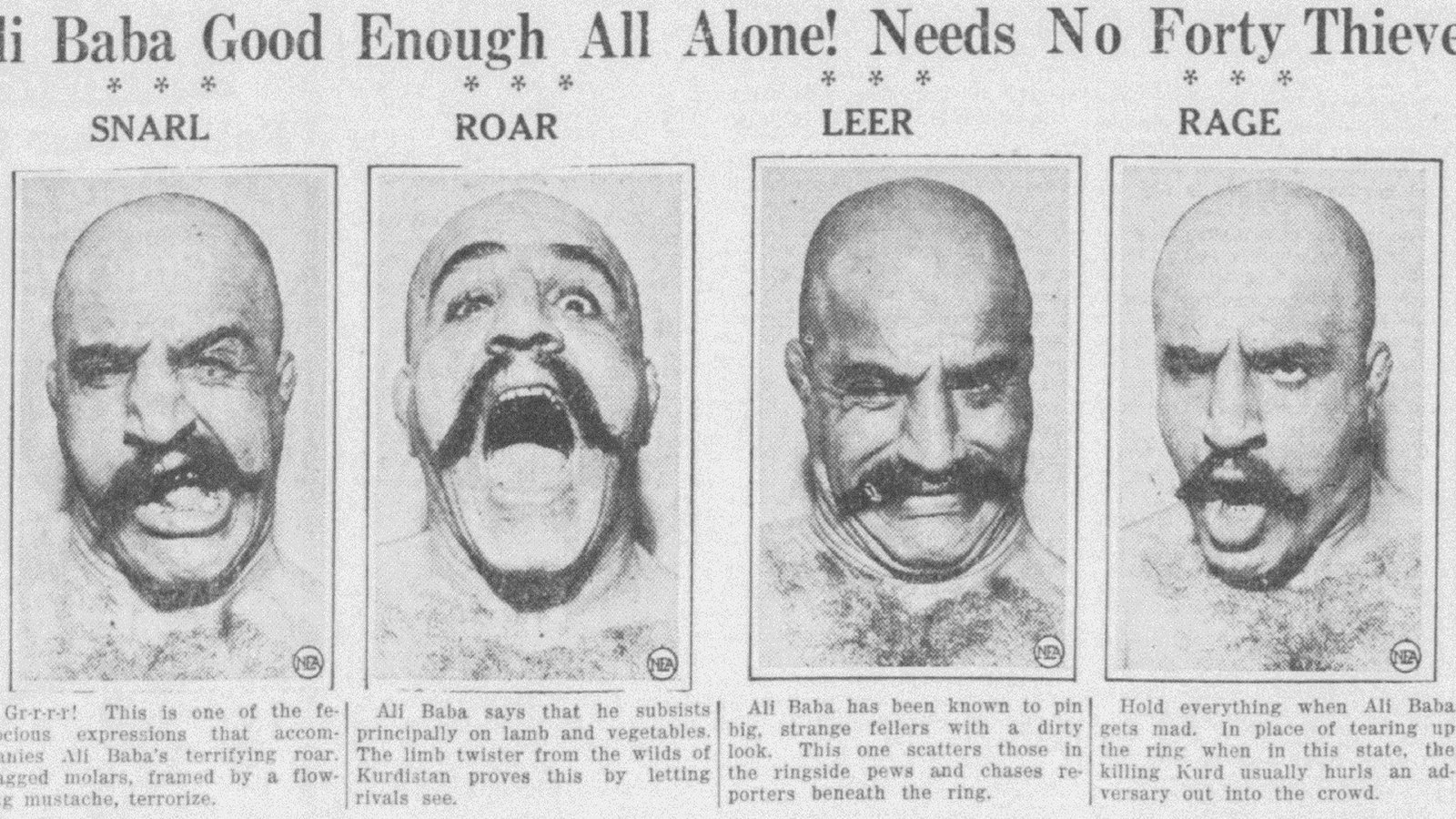
18. Ali Baba: The Terrible Turk Who Was a Pre-TV World Champion
Arteen Ekizian, an Armenian Genocide survivor and former U.S. Navy wrestling champion honored by President Coolidge, rose as the ultimate pro wrestling heel Ali Baba in the 1930s, capturing the World Heavyweight title from Dick Shikat in Detroit on April 24, 1936. Portraying a fearsome Terrible Turk with fez, shaved head, and walrus mustache, he drew massive heat as a foreign villain in various territories. Photo Credit: WWE.
Ali Baba was billed as The Terrible Turk and was one of the most visually menacing presences in pre-television wrestling.
Born Arteen Ekizian on September 28, 1901, in Samsun in the Ottoman Empire, he was Armenian, a survivor of a genocide carried out against his people by the very nation his ring character was meant to represent. His mother lost her husband to the killings and was driven to madness.
Ekizian escaped with help from his uncle and arrived in the United States in 1920. The irony that he would spend the next three decades playing a Turkish villain for American crowds was not lost on those who knew his story.
He was not a large man. Standing 5’5″ and weighing around 200 pounds, he was, according to Sid Feder’s 1952 wrestling guide, Wrestling Fan’s Book, the smallest man ever to hold the world heavyweight championship and the first ever to lose it on a foul.
Before any of that, he had become the Fleet Champion of the United States Navy in the middleweight, light heavyweight, and heavyweight divisions, won an international match in Copenhagen, and, in 1927, was honored at a White House reception by President Calvin Coolidge as the World Champion Navy Wrestler.
He started his professional wrestling career in 1932 in Los Angeles, appearing in Hollywood films on the side, including “Island of Lost Souls” and W.C. Fields’ 1935 comedy “The Man on the Flying Trapeze.”
On April 24, 1936, in front of more than 8,000 fans in Detroit, he defeated reigning World Heavyweight Champion Dick Shikat to capture the title. The date was the annual day of commemoration for the Armenian Genocide.
The New York State Athletic Commission refused to recognize the result, so on May 5 at Madison Square Garden, Ekizian went out and defeated Shikat again, this time in 53 minutes and 37 seconds, and was formally declared World Champion.
The Pittsburgh Post-Gazette described Baba as weighing some 212 pounds, “190 pounds of which,” they wrote, “is said to be stored in his angry mustache.”
The promotional photographs taken of him are still striking. He looked like a genuine threat, the kind of face that sells a poster without a single word of copy, and promoters across the country understood exactly how to use that. He was billed as “the last undisputed world champion” by those who kept track of such things, a distinction earned in the fractured title landscape of the 1930s.
Ali Baba belongs in any serious conversation about the foundations of the foreign-villain archetype in professional wrestling. The Terrible Turk gimmick, an outsider with contempt for American audiences and the in-ring ability to back up every bit of it, became one of the most recycled templates in the history of the business. Almost every era produced its own version.
After retiring from the ring, he settled in California’s Central Valley, where he worked as a masseur, using the same hands that had defeated world champions to heal the aches and pains of migrant workers and businessmen alike.
Ali Baba passed away on November 16, 1981, in Detroit, Michigan, at the age of 79. Very little film of him survives, and very little has been written about him outside Armenian-American communities, which makes his place in the history of the business feel like one of its most unfinished sentences.
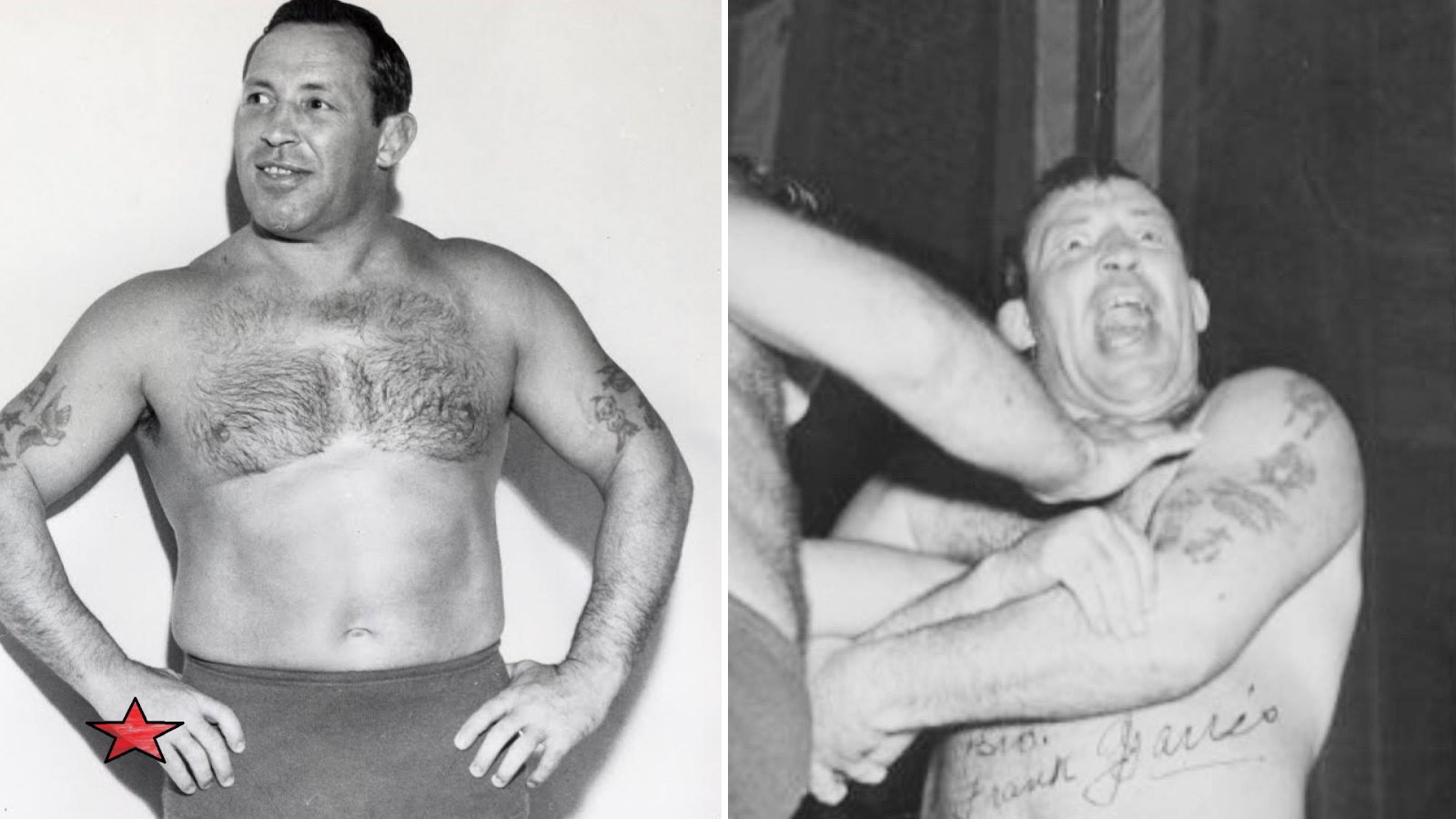
19. Brother Frank Jares: The Dirty Mormon Heel Few Talk About
Frank Jares shifted from 1932 Olympic weightlifting and Pacific Coast amateur wrestling titles to pro villain “Brother Frank, the Mormon Mauler from Provo,” later amplifying heat as flamboyant “The Thing” with orange hair and beard in 1950s arenas. Photo Credit: WWE.
Born on October 6, 1912, in Pittsburgh, Pennsylvania, Frank Jares came to California as a teenager and had his world reshaped at fourteen when both his parents were killed in an automobile accident.
He dropped out of high school, started driving a truck, and found his way to the Los Angeles Athletic Club, where he began wrestling and lifting weights. He became the Pacific Coast amateur wrestling champion and, in 1932, was very nearly placed on the U.S. Olympic weightlifting team as a lightweight-heavyweight, training at Santa Monica’s legendary Muscle Beach through the 1930s and 1940s.
He also lost sight in his right eye to an accidental finger-gouge during an amateur match, an injury that would have ended most athletic careers and barely slowed his.
Brother Frank Jares operated on the fringes of what could be called an early religious hypocrisy heel act, generating heat by playing against an expectation of righteousness. None of it was true, of course. He was not from Provo. He was not a Mormon. He was a Pittsburgh-born Californian who had found a character that worked and ran with it all the way to the bank. The character required very little explanation for any audience, and Jares understood how to use it.
He ran several identities over the course of his career, including Brother Russell and The Golden Terror, a yellow-masked villain who prevented every babyface from unmasking him through creative rule-breaking. His most theatrical persona was The Thing, which came with bright orange hair, a matching beard, and a black box that emitted a hissing rattlesnake sound when he pressed a button at ringside.
One woman wrote to him that she got so mad watching him wrestle on television that she threw a shoe at the set and broke the tube.
“She said that if I was really a decent type,” Jares once recalled, “I would help her fix it.”
On another occasion, a ringsider gave him a swipe across the forehead that required thirteen stitches to close. “But it was good publicity,” he said afterward. “People jammed the place to see me fight with a bandage on my forehead.”
He also appeared in The Abbott and Costello Show and several other television productions during wrestling’s early television boom, putting his face in front of audiences who might otherwise never have set foot in an arena.
His story has one notable footnote for wrestling historians. His son, Joe Jares, went on to write “Whatever Happened to Gorgeous George?” published in 1974 and later named by Sports Illustrated as one of the 100 best sports books ever written, one of the better-researched and more readable books on the early history of professional wrestling. The book drew on family connections and deep personal knowledge of the era that no outside researcher could have replicated, and it remains a valuable primary source for anyone serious about the pre-television period of the business.
After retiring from wrestling in 1959, Frank Jares worked as a butcher at a packinghouse in the San Fernando Valley until a knee injury forced him to stop.
He passed away on July 24, 1990, in Valencia, California, at the age of 77.
Brother Frank Jares is another name that deserves more attention than wrestling history has given him. The fact that his son felt compelled to document the era in print suggests that the stories passed down from that world were too good to let disappear entirely.
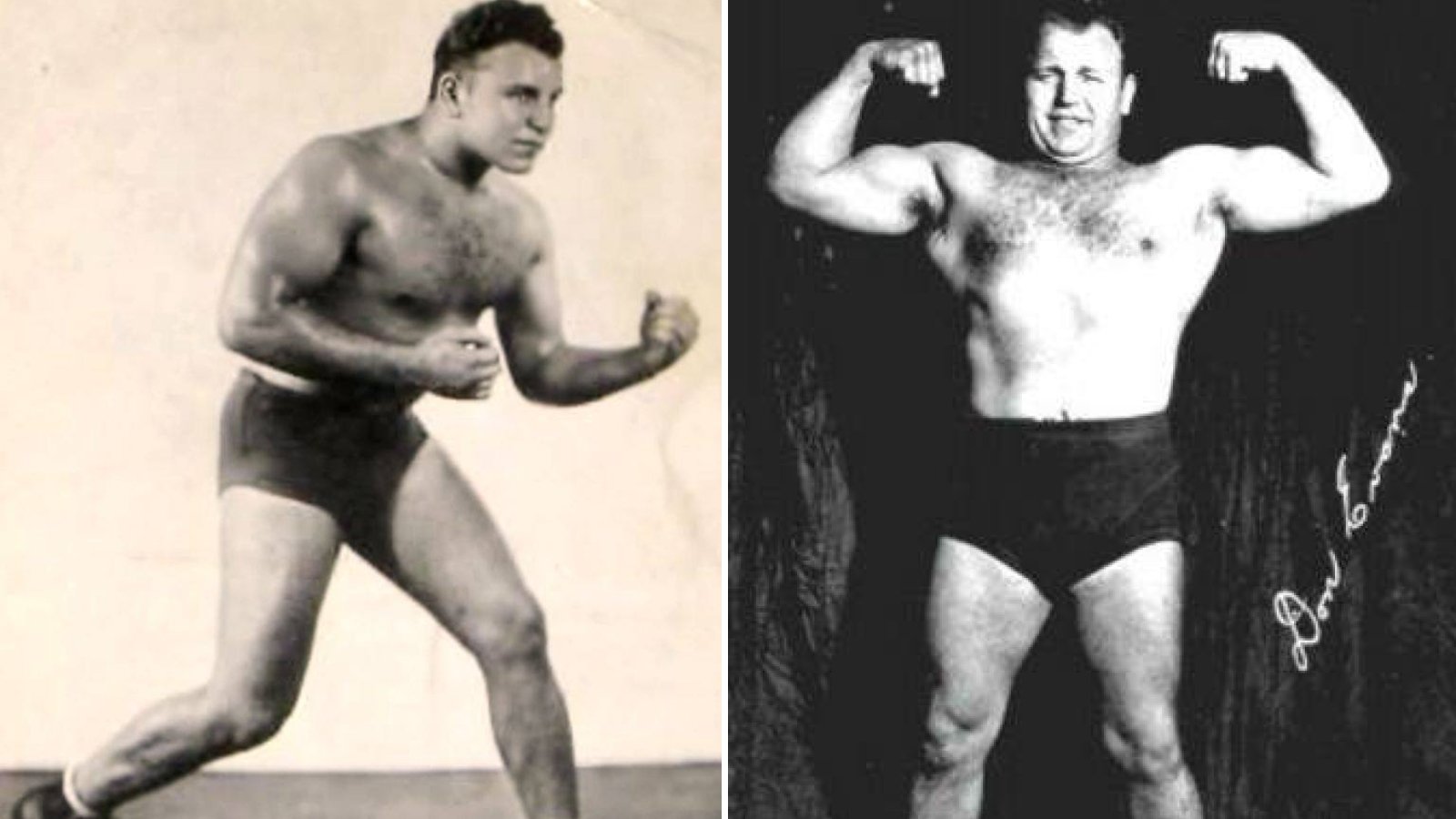
20. Don Evans: The Original One Man Gang Who Needed Police to Leave the Ring
Don Evans debuted late 1930s from South Kortright, New York as rugged brawler Dirty Don or One Man Gang Evans, unmasked as The Masked Phantom in 1945, and terrorized territories for 30 years with over 2300 matches through 1968. The hard-nosed heel tested legends like Bull Curry, defeating him for the Texas Brass Knuckles Title in 1956. Photo Credit: WWE.
Long before George Gray adopted the One Man Gang persona in the mid-1980s and became a fixture in the WWF and NWA, Don “One Man Gang” Evans was making arenas genuinely uncomfortable with a brand of chaos that had very little performance about it.
Born Donald A. Evans on June 22, 1917, in South Kortright, New York, the 5’11”, 227-pound brawler started out as a legal, orthodox wrestler. That changed after Bobby Managoff broke his leg in a match, putting him on the shelf for 16 months. When he came back, he brought out all the back-alley stuff and never put it away again.
By his own account, of his 1,500 opponents, more than 500 needed medical attention after their match with him, and 300 went to the hospital. That was not a boast. It was a business model.
Evans was a rough-houser who specialized in mayhem, the kind of performer who didn’t just bend the rules but treated them as entirely irrelevant. His matches regularly deteriorated into scenes that required outside intervention, and he was among the first wrestlers to turn the police-removal spot into a reliable and repeatable heat generator.
Getting dragged physically out of the ring by law enforcement became a regular part of his presentation, a spot that communicated something no title belt or promo ever could: that this man was so genuinely out of control that the promotion itself could not contain him.
In Texas, where the Brass Knuckles Championship had been built specifically around Wild Bull Curry’s mayhem, Evans walked into Fort Worth on March 19, 1956, and took the title from Curry. He held it for exactly seven days before Curry won it back on March 26 in the same building. Seven days was apparently all Evans needed to make his point.
He also held the NWA Texas Tag Team titles alongside Duke Keomuka, demonstrating that his value extended well beyond his solo chaos.
Promoters quickly realized that a wrestler who required actual removal by authorities was worth more at the gate than almost anything they could otherwise book.
Evans helped establish that truth, and heels have been using variations of it ever since. Every time a modern wrestler gets escorted from the ring by security or restrained by officials at ringside, the lineage of that spot traces back to performers like Don Evans, who proved it worked when television didn’t even exist yet.
Don Evans passed away on November 28, 2005, in Oswego, New York, at the age of 88.
21. Dangerous Danny McShain: Ten-Time Light Heavyweight Champion and Master Cheater
Danny McShain, born in Little Rock in 1912, became one of the territorial era’s most feared heels, racking up a record ten reigns as NWA World Light Heavyweight Champion and multiple NWA Texas Heavyweight and Brass Knuckles titles across the 1930s–1960s while brutalizing babyfaces like Verne Gagne and Antonino Rocca with his Irish Cannonball and piledriver. Photo Credit: WWE.
Born on October 30, 1912, in Little Rock, Arkansas, Danny McShain made his professional wrestling debut on his eighteenth birthday and spent the next thirty-seven years in the business as one of its most reliably entertaining bad guys. He was stocky and handsome with a Hollywood look that had him regularly compared to film actors of the era, which made the gap between his appearance and his behavior in the ring all the more effective as a heat tool.
A genuinely skilled wrestler who felt the need to use every dirty trick available to him anyway, McShain won his first NWA World Light Heavyweight Championship on October 11, 1937, and went on to hold it ten times over the following decade. He also held the NWA Texas Heavyweight Championship ten times between 1948 and 1960, defeating opponents that included a young Antonino Rocca and Verne Gagne. On November 19, 1951, in Memphis, Tennessee, he defeated Gagne again to capture the NWA World Junior Heavyweight Championship.
His ring style was not subtle. He proudly advertised his list of career injuries as proof of the punishment his body had absorbed. He bladed regularly, cutting his own forehead during matches to draw blood. He was a stiff worker who put legitimate force behind his punches and made genuine contact. He was once arrested after starting a riot by spitting tobacco juice from his trademark cigar onto an opponent. His behavior was considered so out of bounds that he was summoned before the Texas Gaming Commission on more than one occasion.
One of the more remarkable footnotes in his career involves a title match that went so sideways, with two promoters arguing over a contested territory and a championship on the line, that the United States Department of Justice became involved. The fallout from that match led directly to the rule, still used in promotions today, that prevents a title from changing hands when a match ends by disqualification. McShain did not invent that rule. He made it necessary.
McShain successfully made the transition to television, primarily in Texas, where his finishing hold, the Diamond Drill Twist, gave him a signature weapon in the new visual medium. He is one of the cleaner bridges between the pre-TV era of rough-and-tumble wrestling and the showmanship television demanded. After retiring from in-ring competition, he worked as a referee in Texas. Danny McShain passed away on July 14, 1992, in Alvin, Texas, at the age of 79.
22. Abe “King Kong” Kashey: The Big Man Who Brought His Brother Along
Abe Kashey, born in Syria in 1903, debuted as Turk Abad Kasa in 1930 before becoming the monstrous heel “King Kong” Kashey, terrorizing U.S. territories for nearly 40 years with his massive frame and brutal brawling style against stars like Dory Funk Sr. in 1950s Texas matches. A Hawaiian Heavyweight Champion known for wild disqualifications and post-match riots. Photo Credit: WWE.
Abe “King Kong” Kashey was a big, rough performer who understood that size and aggression were their own kind of ring psychology. You didn’t need to explain Abe Kashey to a crowd. One look at him and the situation was clear.
He formed a credible early tag team with his brother Al, and together the Kashey brothers became one of the more feared pairings of the pre-television era. They worked the northeastern territories primarily, where their physical presence and willingness to work outside the rules made them a reliable draw for promoters who needed a team the crowd genuinely wanted to see beaten.
The Kashey brothers were an early example of the family unit as a heel act, a concept the Duseks had pioneered out of Omaha and that promoters would continue reaching for across every generation that followed. There is something immediately readable about a pair of brothers working together as heels, a shared menace that feels organic in a way that a manufactured partnership never quite does, and the Kasheys understood how to project that.
Abe Kashey is another name that the written history of professional wrestling has largely passed over. But in the arenas where he and Al worked, the name meant something specific, and the crowds who packed those buildings to watch someone finally put them in their place knew exactly what they were paying for.
23. George Zaharias: The Crying Greek Married to the Greatest Female Athlete Alive
George Zaharias was popularly known in the 1930s as "The Crying Greek from Cripple Creek" and "The Greek Hyena," a villainous heavyweight whose emotional outbursts and sore-loser persona made him a reliable crowd antagonist. One of his most celebrated bouts came in 1932 against Jim Londos before a sold-out crowd of 14,500 at Maple Leaf Gardens in Toronto, the largest attendance for any North American wrestling match that year, with Londos emerging victorious. Photo Credit: WWE.
Born Theodore Vetoyanis on February 15, 1908, in Pueblo, Colorado, George Zaharias built his heel identity around a nickname that sounds almost comic until you understand how he deployed it: the Crying Greek from Cripple Creek. He was a skilled performer who never quite won crowds over, which made him a useful and dependable long-term heel across multiple territories throughout the 1930s and 1940s.
He was a large man, standing 6’2″ and weighing around 230 pounds at his peak, and he used his size as both a physical and psychological tool. The contrast between the weeping, complaining persona and the sheer physical intimidation he brought to the ring was exactly the kind of contradiction that generates reliable heat.
His most famous connection to the wider culture was his wife, Mildred “Babe” Didrikson, one of the greatest female athletes in American history. Didrikson had won two gold medals and one silver at the 1932 Los Angeles Olympics before turning to professional golf, where she won ten major championships and co-founded the Ladies Professional Golf Association. The two married in 1938. On occasion, Zaharias used the name Babe Zaharias in his wrestling billing, an early and remarkably effective form of celebrity cross-promotion that connected professional wrestling to a mainstream sports audience it rarely reached.
His brother Chris was also part of the business, and together they were one of the early bad guy tag team combinations that television would later help popularize across the country. At some point, a promoter or announcer dubbed his brother Chris “Onion Head” Zaharias, a nickname born from his bald head that is difficult to forget once heard and must have done exactly what it was designed to do every time it was announced.
George Zaharias passed away on May 22, 1984, in Tampa, Florida, at the age of 76. He outlived Babe, who died of cancer in 1956 at the age of 45, by nearly three decades.
24. Wild Red Berry: From Main Event Heel to One of Pro Wrestling’s Most Colorful Managers
Ralph L. Berry, known as Wild Red Berry, transitioned from Kansas State Middleweight boxing champ to pro wrestling villain in the 1930s, using rule-breaking antics like eye-powder gouges to win nine NWA World Light Heavyweight titles against foes like Danny McShain. The 5’8″ heel incited riots with his wildman persona and derby-clad promos before later managing The Fabulous Kangaroos and Gorilla Monsoon in the WWWF as the loudmouth “I Am Right” mouthpiece. Photo Credit: WWE.
Born Robert Walter Berry on June 6, 1905, in Little Rock, Arkansas, Wild Red Berry spent the 1930s and 1940s as a legitimate main-event performer in the lighter-weight classes, at a time when lighter-weight wrestlers were expected to work twice as hard for half the recognition. Berry worked harder than most and got more recognition than almost any of them.
He held the World Lightweight Championship, the Central States Championship, the Arkansas Junior Heavyweight Championship, and the World Light Heavyweight Championship twice, a title haul that reflected both his in-ring ability and his instinct for positioning himself where the money was.
His explanation for his reliance on dirty tactics was simple and honest: he was always the smallest man in the ring. In a pre-television era where size was currency, Berry compensated with guile, rule-breaking, and a thorough understanding of how to make a crowd want to see him beaten. He was so effective at generating heat precisely because nobody expected a smaller man to be so infuriating.
When he retired from active competition in the 1950s, he channeled everything he knew about heat and presentation into managing The Fabulous Kangaroos, the legendary Australian tag team of Al Costello and Roy Heffernan that became one of the most decorated tag teams in the history of the business, winning the NWA United States Tag Team Championship and the AWA World Tag Team Championship among numerous other titles.
Berry was vaccinated with a dictionary. He described everything in enormous, multi-syllabic terms, deploying language as a weapon the same way he had once deployed a well-timed low blow. It was the same heat, delivered through a different instrument. Nick Bockwinkel would later bring that particular gimmick to its fullest and most polished expression, but Wild Red Berry was doing it first.
Wild Red Berry passed away on October 18, 1973, in New York City, at the age of 68.
25. Dutch Rohde: Before He Was Nature Boy, The Early Heel Career of Buddy Rogers
Herman Gustav Rohde Jr., better known as Buddy Rogers, began his storied career as Dutch Rohde or Dutch Rogers in 1939 New Jersey after amateur wrestling at the shipyards, quickly rising as a hard-hitting heavyweight with devastating dropkicks that floored opponents like Kay Bell during his 1940s-1950s territorial dominance. Photo Credit: WWE.
Herman Gustav Rohde Jr. was born February 20, 1921, in Camden, New Jersey, and spent time in a traveling circus before becoming a professional wrestler. By the mid-1940s, he had worked his way into main events, primarily in Al Haft’s Columbus, Ohio promotion. In 1945, he underwent what he described as an epiphany, changing his ring name from Dutch Rohde to Buddy Rogers, and the business would never be quite the same.
Along the way, he crossed paths with a young woman then known as Slave Girl Moolah, born Mary Lillian Ellison in Tookiedoo, South Carolina, who briefly served as his ring valet. That arrangement allegedly came to an abrupt end during a drive between Dallas and Houston when Rogers told her plainly that she was either going to put out or get out. She went straight to the promoter. Rogers was reprimanded, the partnership was over, and that was that.
Moolah went on to become The Fabulous Moolah, holding the NWA Women’s World Championship for a combined total of more than twenty years, one of the longest championship reigns in the history of the business. Rogers lost a valet. The business gained one of its most enduring figures.
What truly elevated Rogers from talented heel to generational figure was the Nature Boy character, which emerged in 1948. The inspiration came in part from a film called “The Boy with the Green Hair” and its title song, “Nature Boy,” which had become a major hit for Nat King Cole that same year. Texas promoters recognized the cultural moment and wanted to build a wrestling character around the song’s mystique.
The character took shape when Rogers connected with Ohio promoter Jack Pfefer, the same eccentric character architect who had been building wrestling personas out of thin air for two decades. Pfefer dubbed him the “Natural Guy,” a name that didn’t fully stick but pointed in the right direction. Rogers refined it, bleached his hair blonde, amplified the strut and the swagger, and the Natural Guy became the Nature Boy.
He challenged Orville Brown for the NWA World title in California in November 1948 under the new character, and from that point forward, the gimmick belonged entirely to him.
One story that has passed through wrestling circles for decades holds that Rogers was not the first man offered the Nature Boy character. Another wrestler, who also served as a pastor on weekends, was approached first and turned it down flat. He wanted no part of the persona it required. His identity has never been nailed down in any written record, which is fitting for an era that kept more secrets than it ever put on paper. Rogers had no such conflict. He took the character and never let go of it.
Together with Killer Kowalski, Rogers was also among the first professional wrestlers to publicly advocate for diet and serious physical training as deliberate components of a wrestling career. The idea that a wrestler’s body was a professional instrument requiring maintenance and attention was not a given in the 1940s. Buddy Rogers helped make it so.
Rogers went on to become the first recognized NWA World Heavyweight Champion under the consolidated Alliance, holding the title from January 1961 until losing it to Lou Thesz in Toronto on January 24, 1963. He was also recognized as the first WWWF World Heavyweight Champion in 1963, making him the man from whom Bruno Sammartino would win that title to begin one of the most celebrated championship reigns in wrestling history. He passed away on June 26, 1992, in Fort Lauderdale, Florida, at the age of 71.
The Nature Boy character Rogers built in 1948 out of a Nat King Cole song and a Texas promoter’s instinct never truly left the business. Ric Flair took the name, the robe, and the strut and carried them into the twenty-first century. That is the kind of legacy that very few performers in any era of any sport or entertainment have ever built, and it started with a man named Dutch Rohde who said yes when someone else said no.
The Foundation Pre-TV Heels Left Behind
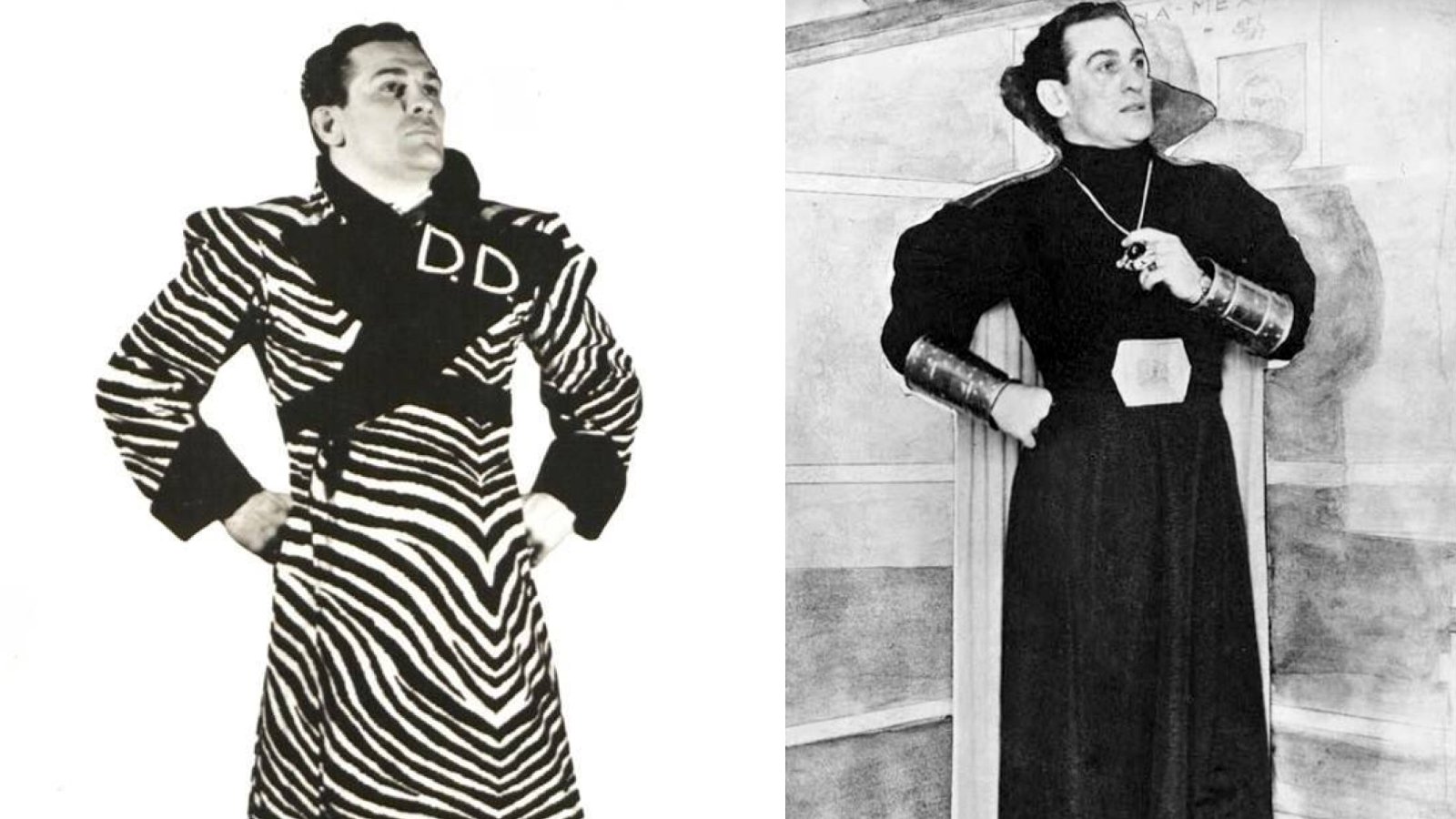
Gorgeous George Wagner revolutionized wrestling’s next era as the flamboyant villain who debuted the character in 1945, taking inspiration from so many of the names included on this list. Photo Credit: WWE.
Almost none of these men appear in mainstream wrestling histories. There is very little film. Many of their matches exist only as results printed in old newspapers that themselves are now yellowing in archive boxes somewhere, waiting for a researcher patient enough to find them.
But the work they did matters. The heat they generated, the championships they held, the creative choices they made in a time when there was no television to reward them, no national platform to amplify them, and no playbook to follow, shaped every villain who came after them in ways that the business has never fully acknowledged.
Think about what they built from scratch. The dirty stable, a group of legitimate wrestlers who also happened to know every rule worth breaking. The brawler so out of control that law enforcement had to drag him from the ring. The masked mystery man who offered to reveal his face if you could beat him, a promise that sold tickets for decades. The foreign outsider with open contempt for the audience. The aristocrat with a manservant and entrance music. The technically gifted wrestler who cheats anyway, because winning clean was never really the point. The riot-starter who made arenas feel genuinely unsafe.
Every one of those archetypes existed before a single wrestling match was ever broadcast on television. They were built in the 1930s and 1940s in front of live crowds, tested night after night in arenas that smelled like sweat and cigar smoke, refined through the immediate and unfiltered response of audiences who had paid their money and expected something worth the trip.
Television didn’t create these characters. It inherited them. What the camera did was take what performers like the Dusek Riot Squad, Wild Bill Longson, Wild Bull Curry, Lord Patrick Lansdowne, and others on this list had already proven would work and deliver it to a living-room audience of millions. The amplification was television’s contribution. The invention belonged to the men in this article.
Those arenas were full of people who had driven hours to watch these men finally get what they deserved.
Pro Wrestling Stories is committed to accurate, unbiased wrestling content rigorously fact-checked and verified by our team of researchers and editors. Any inaccuracies are quickly corrected, with updates timestamped in the article's byline header.
Got a correction, tip, or story idea for Pro Wrestling Stories? Contact us! Learn about our editorial standards here. Ever wanted to learn more about the people behind Pro Wrestling Stories? Meet our authors! Want to write for us? Learn how to join the team.
Quick Tip for Facebook Readers
Many of our readers find us through
our Facebook page.
Meta's built in browser (which opens by default on mobile) can occasionally freeze mid article, a known issue unrelated to our site.
For uninterrupted reading: tap the three dots in the top right corner then select 'Open in external browser'.
That usually resolves the glitch. Thanks for your support and we want your wrestling stories to stay as smooth as a top rope hurricanrana!
ProWrestlingStories.com participates in affiliate marketing programs. This post may contain affiliate links, meaning we may earn commissions at no extra cost to our readers. This supports our mission to deliver free content for you to enjoy!
Ted Holland is a devoted researcher and historian who has spent over six decades collecting wrestling photographs, memorabilia, and oral histories from professional wrestling’s territorial golden age. He meticulously examines archives, from classic films and vintage television to rare publications and wrestling records, preserving stories that might otherwise fade from history. Currently, Ted writes political humor for Humor Times Magazine and contributes features on classic B Westerns to Wrangler’s Roost Magazine. His published books include The B Western Actors Encyclopedia and This Day in African American Music. His extensive Gene Gordon photography collection and firsthand accounts from wrestling personalities provide unique primary source documentation of wrestling’s most influential eras and unforgettable moments.
 Author: