In August 1985, inside a sweltering Osaka-jō Hall, fans wept and hyperventilated in their seats. They came to watch Chigusa Nagayo of the Crush Gals battle the villainous Dump Matsumoto. What they witnessed was something no one had prepared for. Months of carefully engineered heat had reached a breaking point, and once it slipped beyond AJW’s control, the line between performance and reality vanished. For Matsumoto, the real danger began the moment she left the ring. The hatred AJW had spent months building had outgrown the arena, and it was now coming for her personally.
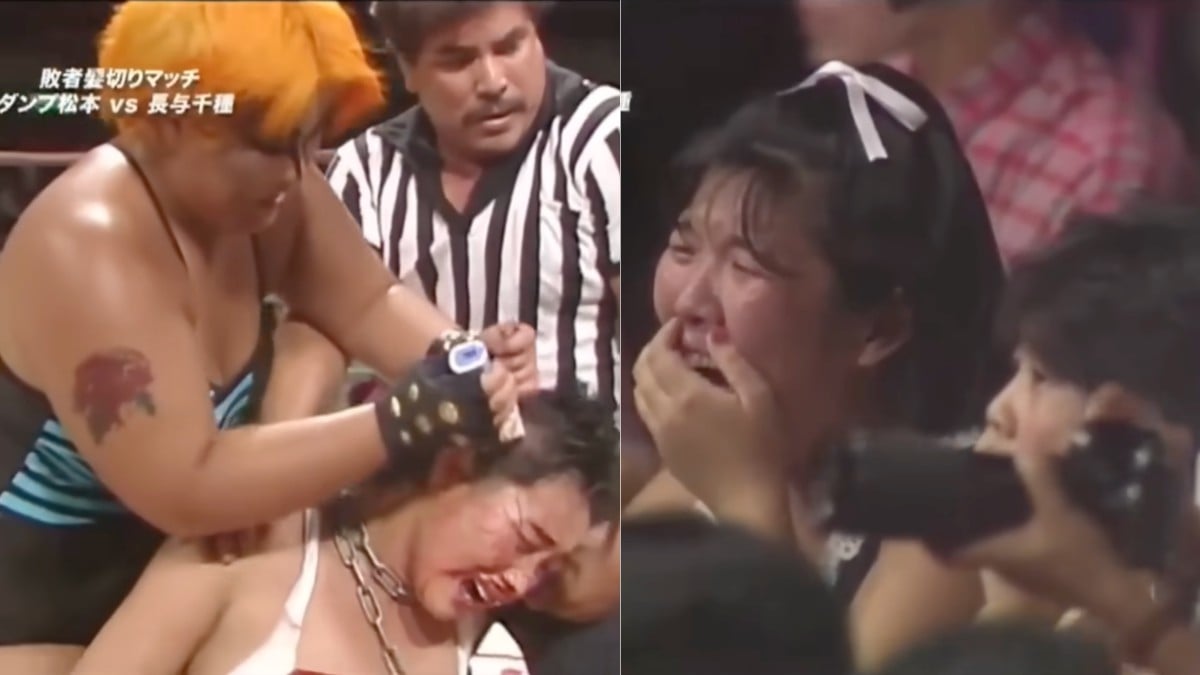
A young fan breaks down inside Osaka-jō Hall on August 28, 1985. She was not alone. More than 11,000 came for the hair vs. hair match between Chigusa Nagayo and Dump Matsumoto. What they witnessed was something no one had prepared for. Photo Credit: Artwork on left- George Morikawa/Kodansha, right- AJW.
Our wrestling history is gold, and so are readers like you!
If the following story adds to your collection of wrestling knowledge, you can:
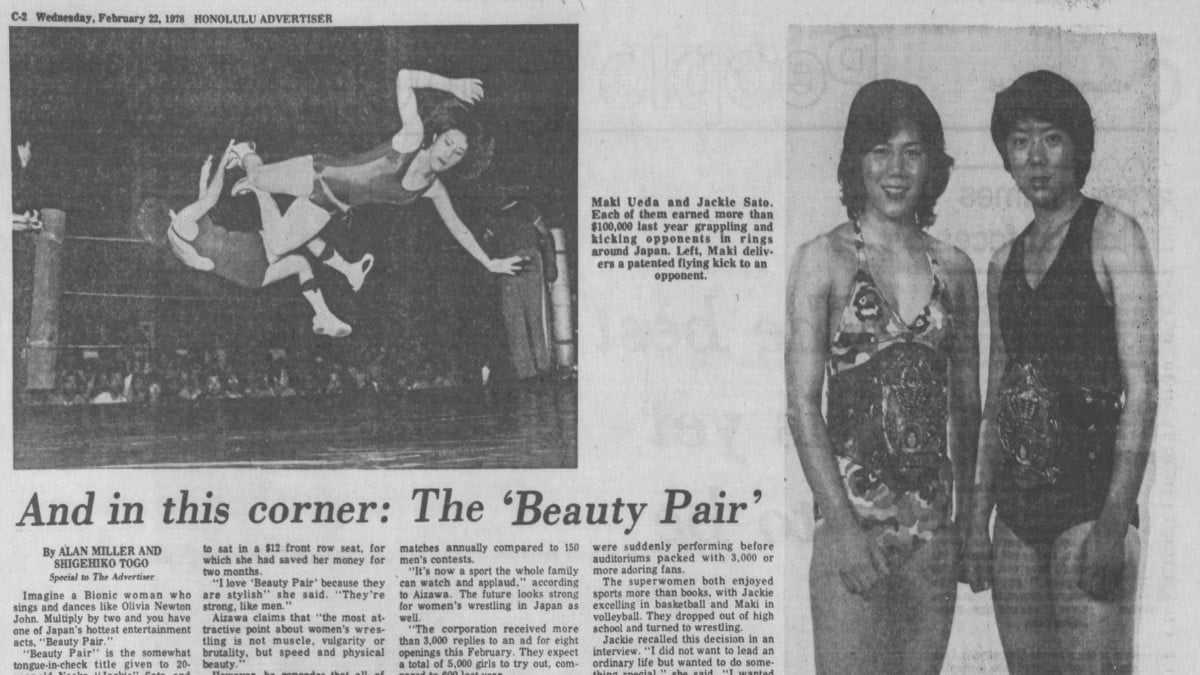
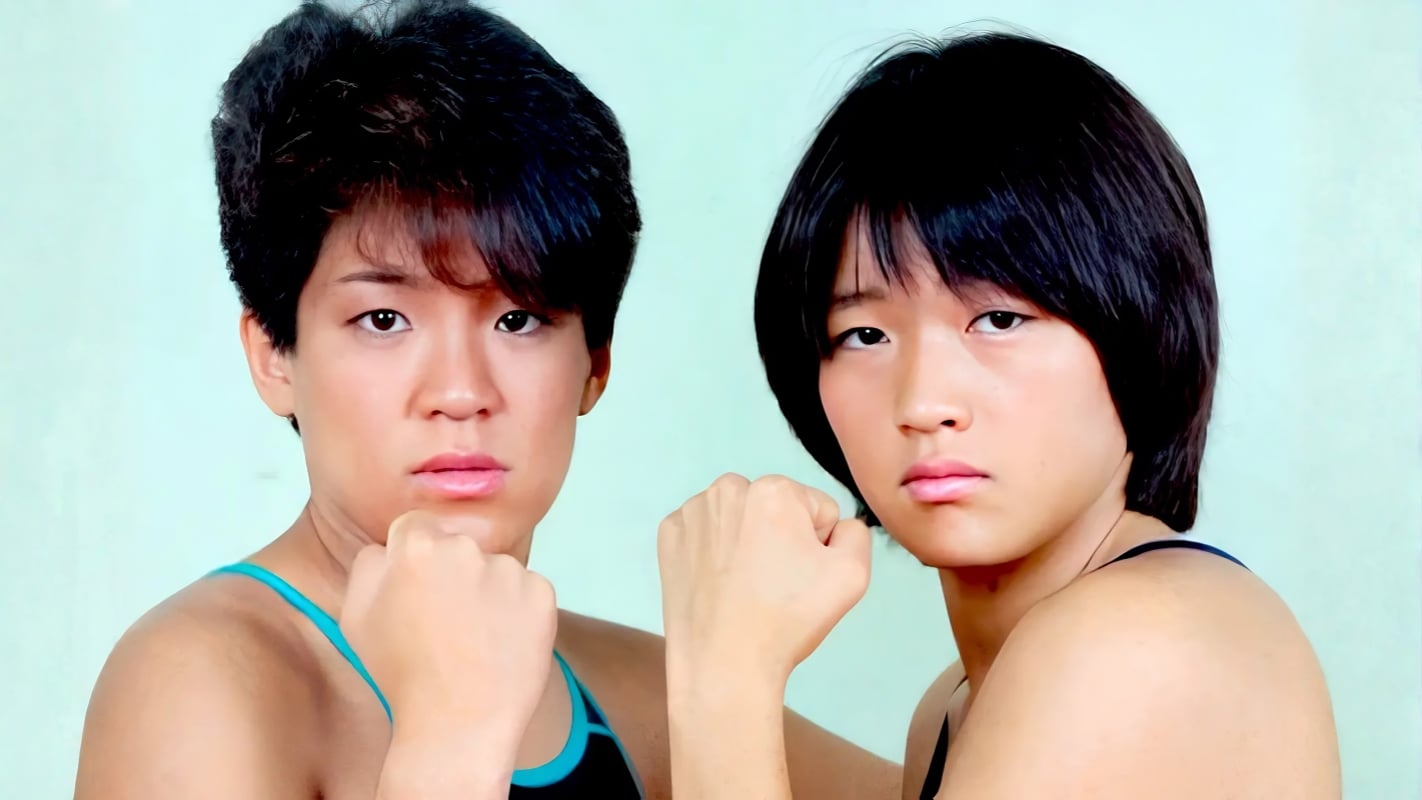
Jackie Sato and Maki Ueda of the Beauty Pair, featured in the 1978 Honolulu Advertiser. The duo’s idol-wrestler crossover formula laid the groundwork for the Crush Gals’ rise in All Japan Women’s Pro-Wrestling. Photo Credit: Honolulu Advertiser.
To understand the intricacies of the feud that would eventually consume the nation, one must first examine the environment that birthed it.
In the mid-1980s, the Japanese television landscape was dominated by an unlikely cultural phenomenon, one that transcended the traditional boundaries of sport and entertainment. At a time when women’s professional wrestling in North America was often relegated to side-show status or novelty attractions, All Japan Women’s Pro-Wrestling (AJW) achieved a level of national penetration that rivaled popular sitcoms and variety programs in the country.
AJW, founded in 1968 by Takashi Matsunaga and his brothers, initially operated under a traditional booking structure, Japanese faces battling foreign heels, largely imported from North America. That framework began to shift dramatically in 1975 with the rise of Mach Fumiake, a teenage prodigy who had previously gained national recognition as a runner-up on the singing competition Star Tanjou.
Fumiake represented the first true joshi-idol crossover star, proving that the wrestling ring could double as a stage for multi-talented entertainers who could sing, dance, and act as well as fight. Though her career was brief, its impact was lasting. She established the formula for success that AJW would replicate for decades, the fusion of professional wrestling with Japan’s rapidly expanding idol culture.
The most significant precursors to what would come next were the Beauty Pair, Jackie Sato and Maki Ueda, who dominated AJW from 1976 to 1979. They became a genuine pop-cultural phenomenon, selling over 800,000 copies of their debut single Kakemeguru Seishun and starring in their own feature film. More importantly, they taught promoters how to market women’s wrestling directly to female audiences, blending athletic heroism with idol spectacle and an androgynous aesthetic.
The Beauty Pair did more than define an era. They built the cultural template, the audience, and the commercial machinery that laid the foundation for the cultural juggernaut that would soon follow.
The Crush Gals: Japan’s Biggest Pop-Wrestling Phenomenon
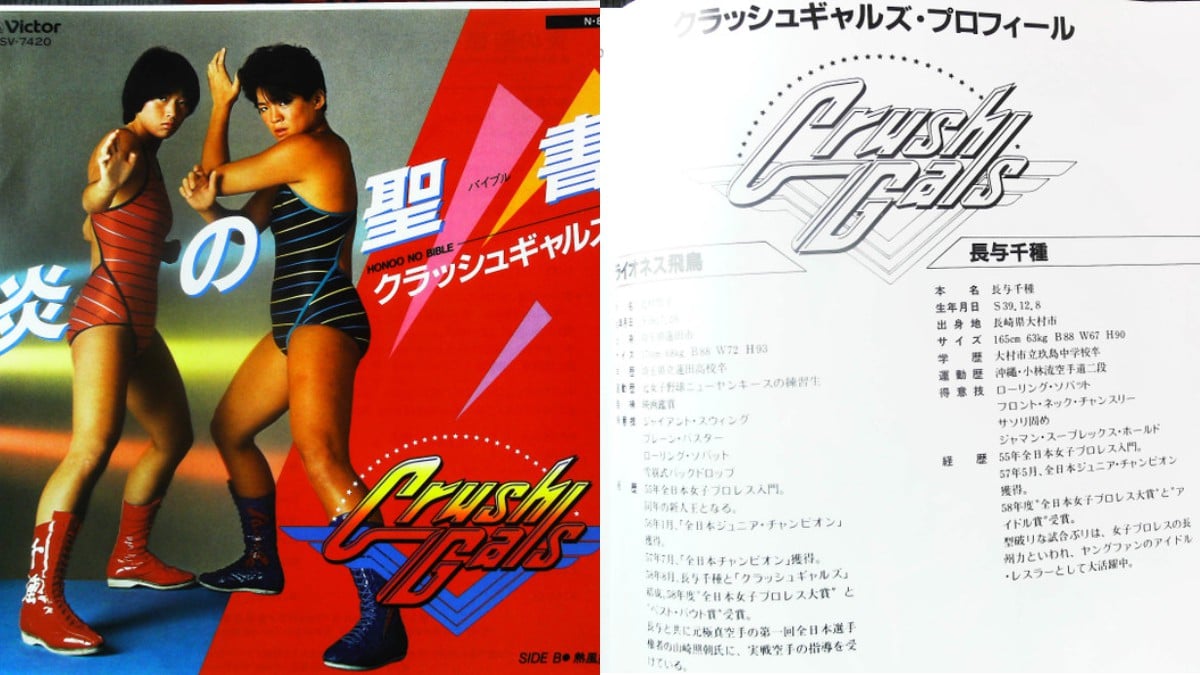
Lioness Asuka and Chigusa Nagayo of the Crush Gals on the cover of their 1984 debut single “Bible of Fire,” a release that sold over 100,000 copies and cemented their status as pop-wrestling crossover stars in 1980s Japan. Photo Credit: Discogs.
In the wake of the Beauty Pair’s breakthrough, AJW was no longer simply cultivating stars. It was poised to manufacture a national obsession. The company had already established the formula, athletic heroines packaged with idol appeal, capable of commanding both the ring and the broader popular imagination. What it needed now was the perfect pair to ignite the next, unprecedented wave.
That pair arrived in the form of Lioness Asuka (Tomoko Kitamura), whose ring name would later inspire one of WWE’s most recognizable stars, and Chigusa Nagayo. Both were products of AJW’s early-1980s system, and together they represented an ideal synthesis of intensity and accessibility.
Asuka’s explosive athleticism, paired with Nagayo’s resilience and emotional authenticity, made them uniquely compelling to a rapidly expanding youth audience.
The turning point came on January 4, 1983, when the two faced each other in a match that sparked an unmistakable reaction from the crowd. AJW’s management immediately recognized what they were witnessing and quickly paired them together as the Crush Gals, a name that blended Akira Maeda’s “Crush” nickname with the title of a popular girls’ magazine, Gals.
Almost immediately, the Crush Gals became something larger than wrestling stars. Their blend of youthful charisma, athletic credibility, and idol accessibility pushed AJW beyond the boundaries of niche fandom and into the center of mainstream youth culture. Historians have compared their national impact in mid-1980s Japan to the scale of Hulk Hogan’s boom in the United States, an indicator of just how completely they captured the public imagination.
By 1984, their fame extended far beyond the ring. In August 1984, they released their debut single Bible of Fire, which sold over 100,000 copies, an extraordinary figure that underscored their crossover power within Japan’s idol economy. Their matches became television events, their image saturated magazines and record stores, and AJW’s popularity reached levels that few women’s sports properties had ever achieved.
Together, Asuka and Nagayo embodied a new archetype, wrestlers who were simultaneously elite athletes, teen idols, and cultural symbols of a more confident, physically powerful femininity. Their popularity elevated AJW to a level of national visibility that demanded larger stakes, sharper contrasts, and an opposing force of comparable magnitude, and it was then that AJW turned to Dump Matsumoto.
Dump Matsumoto: From Obscure Rookie to AJW’s Most Feared Heel
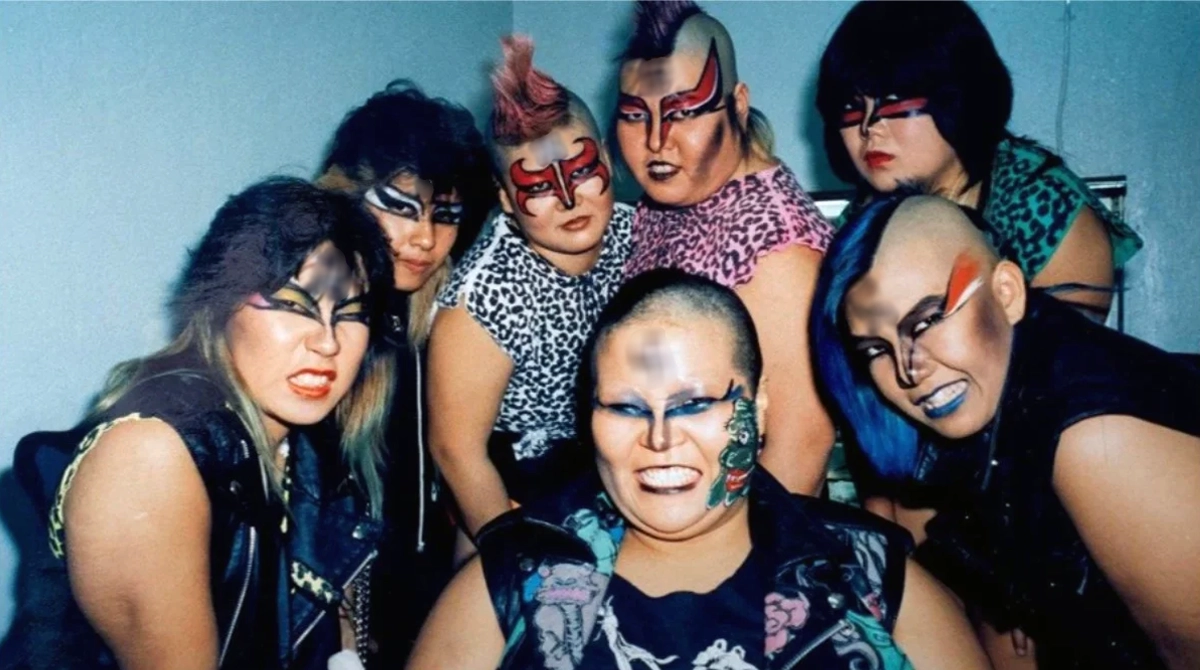
Dump Matsumoto stands with the Gokuaku Domei (Atrocious Alliance), including Bull Nakano and Condor Saito, the faction that defined heel wrestling in 1980s All Japan Women’s Pro-Wrestling (AJW). Certain symbols visible in the original photograph have been obscured in accordance with editorial policy. Photo Credit: Kaoru Kage.
Before she became known nationwide as Dump, she was simply Kaoru Matsumoto, an unremarkable rookie shaped by AJW’s rigid system. In her early years, she worked straightforward matches and struggled to project the kind of charisma that defined the era’s most marketable stars. Her stocky frame and blunt physicality made her an awkward fit for the image AJW typically promoted, and she drifted through the undercard with little sense of momentum.
Despite her unremarkable beginnings on screen, Matsumoto’s life outside the ring had been shaped by deprivation and hardship. Raised in extreme poverty in Kumagaya, Saitama, she grew up in a four-and-a-half tatami apartment with no bath and well water, while her mother supported the family alone by packing cotton for bedding.
Her father, when present at all, drank heavily and brought no money into the house. The violence came to a head one night when, as Matsumoto later recalled in a 16-part series published by Tokyo Sports, her father smashed a glass window in an attempt to strike her mother, leaving the tatami flooded. “I want to do something about this man who is tormenting my beloved mother,” she expressed. “The only way to do that is to be strong. There was a big reason why I wanted to become a professional wrestler after that. I wanted to end my father’s life.”
By late 1982, Matsumoto began edging away from the promotion’s conventional image entirely. Her first sustained step into a more antagonistic role came through Devil Masami’s Devil Corps, a unit that offered structure and menace, and even brought her tangible success, including a championship win over Lioness Asuka. Yet the Devil Corps represented a controlled, authoritarian style of intimidation, disciplined cruelty rather than chaos. Matsumoto, increasingly restless, seemed drawn toward something more abrasive.
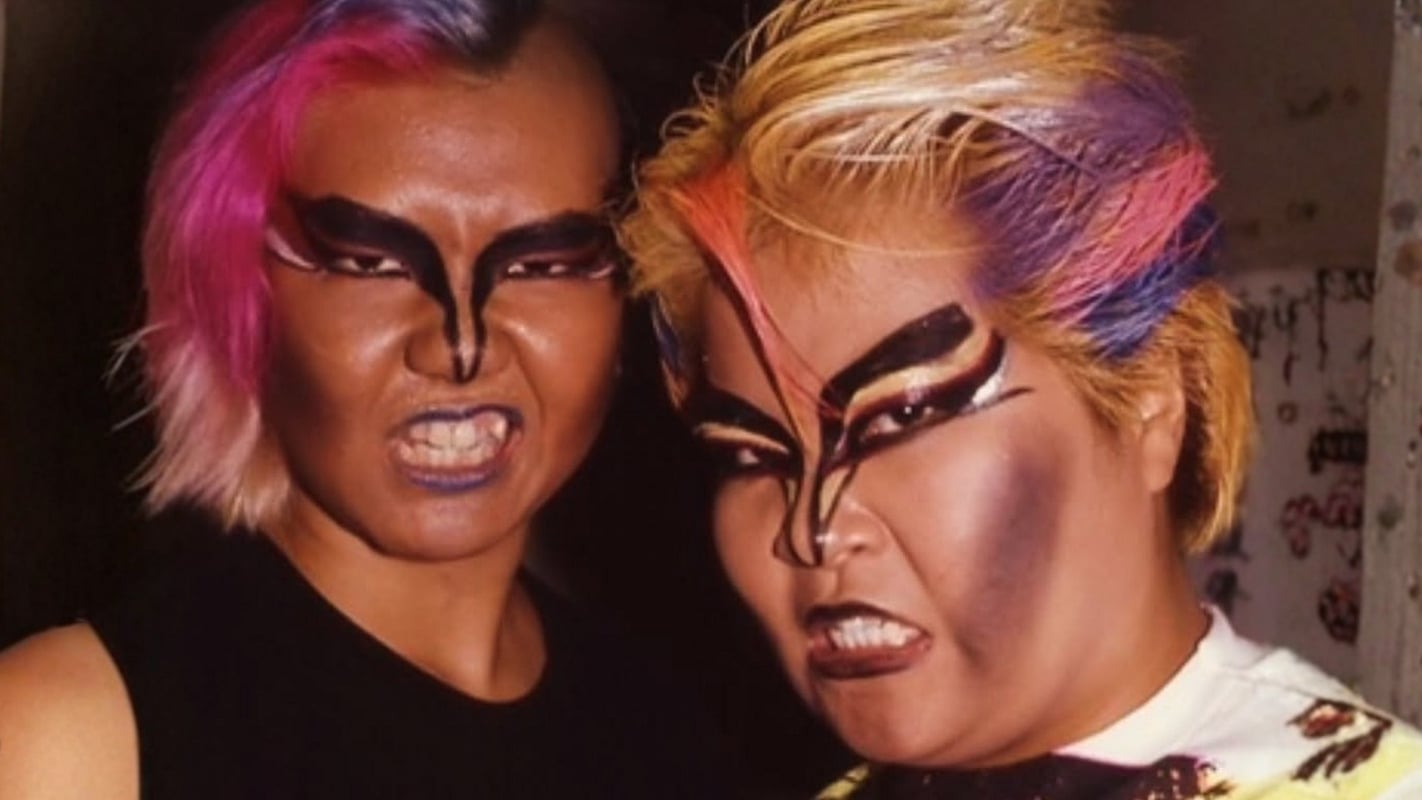
That evolution culminated in January 1984, when she severed herself from her old identity and emerged as Dump Matsumoto. The change was unmistakable: bleached hair, theatrical face paint, black leather, visual cues drawn from glam-rock excess, the rock band KISS, and sukeban delinquent culture. Even the name “Dump,” a nod to her powerful, truck-like build, functioned as a rejection of idol femininity.
As Matsumoto later told Tokyo Sports, the woman who had spent her entire childhood terrified of being disliked by others effectively ceased to exist the moment the new persona took hold.
“Ever since she was a child, Kaoru Matsumoto, who was more afraid of being disliked by others than anything else, and who never stopped smiling, died once at this time,” she reflected. She then wrote her mother what she described as a farewell letter: “Since you are causing trouble for your parents and sister, please assume that your eldest daughter is no more. I’m going to be hated by all of Japan.”
With her new identity in place, she gathered other wrestlers similarly positioned outside AJW’s idol ideal, forming the Gokuaku Domei (Atrocious Alliance) with figures such as Bull Nakano, Crane Yu, and Condor Saito.
To complete the image of total otherness, members of the faction painted a divisive wartime symbol on their foreheads during performances, a deliberate visual provocation designed to signal that the Atrocious Alliance existed entirely outside the boundaries of acceptable society.
The group became a refuge for performers who refused the moralistic sportsmanship and sweetness that the Crush Gals symbolized. They embraced disruption, intimidation, and a deliberate rejection of the promotion’s idol-coded femininity.
In an AJW landscape increasingly defined by adoration for its heroines, Dump Matsumoto emerged as the era’s defining antagonist, an embodiment of everything the Crush Gals’ image left behind.
How AJW Used Kayfabe to Ignite a Nation
Dump Matsumoto and Bull Nakano of the Gokuaku Domei (Atrocious Alliance) in full character: bleached and teased hair, and theatrical face paint, a look drawn from KISS-inspired glam-rock excess and sukeban delinquent culture that made them the most visually striking and feared heels in 1980s All Japan Women’s Pro-Wrestling (AJW). Photo Credit: AJW.
As Dump Matsumoto and the Gokuaku Domei rose to prominence in AJW’s mid-1980s landscape, founder and promoter Takashi Matsunaga began carefully orchestrating their rivalry with the Crush Gals through strict enforcement of kayfabe. He imposed a strict separation between heroes and villains that isolated performers both off-screen and in the ring. Matsumoto was forbidden from being seen in public with any babyface wrestlers, including dojo friends she had lived with for years.
What Matsumoto did not know at the time was how far Matsunaga was willing to go to stoke the fire.
Before every match, he would visit each locker room separately and fabricate quotes from the other side. As Matsumoto recalled, he would look her in the eye and say: “Every day when Chigusa comes to the office, she says, ‘I hate Dump. I don’t want to fight anymore.’ She hates you anyway.”
He delivered the same manufactured animosity in reverse to Nagayo and Asuka.
“I later found out from talking to Chigusa and Asuka that the whole thing was made up by Takashi,” Matsumoto shared. “So it was a big lie.”
When both sides stepped into the ring carrying that fabricated backstory, the intensity that followed was genuine.
The dynamic was further reinforced by the Gokuaku Domei’s ruthless cheating: blatant rule-breaking, constant interference from allies, and endless referee distractions that let Dump escape punishment and steal victories. The sense that the heroes were being denied fairness pulled audiences deeper than a typical wrestling feud ever could.
Reactions in the arena grew louder and more charged, driven not only by support for the Crush Gals but by anger at how often victory seemed to be taken out of their hands. The conflict started to take on a momentum of its own, intensifying week after week without catharsis.
As 1985 progressed, AJW management moved to raise the stakes accordingly. With engagement at unprecedented levels, the promotion built toward its most severe stipulation, the hair vs. hair match.
With hundreds of amazing Pro Wrestling Stories to dive into, where do you start? Get the inside scoop – join our exclusive community of wrestling fans! Receive 10 hand-picked stories curated just for YOU, exclusive weekly content, and an instant welcome gift when you sign up today!
The 1985 Hair Match That Left Osaka in Tears
Dump Matsumoto shaves Chigusa Nagayo’s head following their hair vs. hair match at Osaka-jō Hall on August 28, 1985, a moment that drew wailing, hyperventilating fans and became one of the defining images of 1980s joshi wrestling. Photo Credit: AJW.
The announcement that Chigusa Nagayo of the Crush Gals and Dump Matsumoto would meet with their hair on the line at Osaka-jō Hall was treated in Japan as far more than a routine match stipulation. Hair-versus-hair carried a particular symbolic charge. By the night of August 28, 1985, the atmosphere inside Osaka-jō Hall reflected that weight. Nagayo was carried into the arena on the shoulders of her supporters, her name chanted in unison, while in stark contrast, the Gokuaku Domei entered to a wall of sustained boos.
From the outset, Matsumoto controlled the match through overwhelming physicality, slamming Nagayo repeatedly into the mat and dictating the pace through sheer force. Midway through the contest came the moment that would define the bout’s legacy. Matsumoto produced a pair of industrial scissors and began driving them into Nagayo’s forehead, staining the canvas as she taunted the front rows.
A brutal chair shot would flatten Nagayo, rendering her unable to beat the referee’s count and ending the match. But the stipulation remained, and the consequence was carried out in full view of the audience.
Bull Nakano restrained a sobbing Nagayo with a chain wound around her neck while Matsumoto ran the shears over her scalp. Frenzied wails filled the arena as girls cried, hyperventilating and screaming as they watched their idol defeated and left at the mercy of her opponent.
What endured beyond August 28 was not only what had taken place inside the ring, but the collective trauma of Nagayo’s public humiliation, the spectacle of her image being stripped away in front of the nation.
When Fan Hatred for Dump Matsumoto Turned Dangerous Outside the Ring
Dump Matsumoto’s villainy was so effective that it began to escape the boundaries of the ring. As she attempted to leave Osaka-jō Hall that night, the hostility immediately turned physical.
Between 500 and 600 fans surrounded the Atrocious Alliance’s bus after the match, pounding on it, shaking it violently, and screaming for Matsumoto to come out. “They’re gonna do me in,” she later recalled thinking.
On her walk back to the dressing room, a security guard who had lost control of a fan in the crowd punched her in the face.
The backlash soon reached far beyond the arena.
In the summer of 1985, a young man was spotted following Matsumoto near the AJW dojo in Meguro Ward every day, watching her with what a fellow member of the Atrocious Alliance described as “an amazing expression on his face.” When they grabbed him and took him to the police, he admitted he had been waiting for the right moment to harm her.
In a separate incident, an intoxicated male fan at a bar in Shinagawa Ward broke a bottle and pressed the jagged remains against Matsumoto’s chest. The scar from the attack stayed with her permanently.
The hostility extended into her private life in relentless, personal ways.
Even before the hair match, the hatred was already reaching into her personal life. At the end of 1984, Matsumoto had purchased a brand-new red Nissan Fairlady Z sports car for 3.5 million yen in cash, the equivalent of roughly $14,000 USD at the time, or approximately $42,000 today. On the first day she brought it to the dojo, she found the words "Stupid, die" scratched into the paintwork with a coin. "I cried, at this time," she later recalled.
Taxi drivers sometimes recoiled or refused to pick her up when they recognized her, and even ordinary public encounters were shaped by the resentment her role provoked.
This was the cost of becoming AJW’s ultimate villain, when the persona she had built began to carry consequences that no one in the promotion had anticipated or prepared her for.
The 1986 Rematch: Nagayo’s Revenge at Osaka-jō Hall
Chigusa Nagayo confronts Dump Matsumoto ahead of the November 7, 1986 hair vs. hair rematch at Osaka-jō Hall, the night Nagayo exacted revenge in front of a crowd that had waited over a year for catharsis. Photo Credit: AJW.
The feud would reach its ultimate technical and emotional climax on November 7, 1986, when Chigusa Nagayo and Dump Matsumoto returned to Osaka-jō Hall for a rematch under the same hair-versus-hair stipulation. While the 1985 match had been a short, traumatic brawl, the rematch escalated into a prolonged, physical spectacle. Matsumoto dragged Nagayo around the ring with a chain wound around her neck, reopening the wound on her forehead once again.
The finish became a masterclass in physical storytelling. Matsumoto’s hubris finally backfired when she attempted to attack the referee one last time. The official, exhausted by the abuse, slapped down a fast three-count on Nagayo’s sudden roll-up, ignoring Matsumoto’s frantic shoulder lift. The eruption from the crowd was immediate, a catharsis that had been building for more than a year.
In a rare moment of ring honor, after initially trying to flee, Matsumoto returned and sat silently as her head was shaved, stoic and unmoved, as if refusing to grant the audience even the satisfaction of visible shame.
Dump Matsumoto, the Crush Gals, and an Era That Could Never Be Replaced
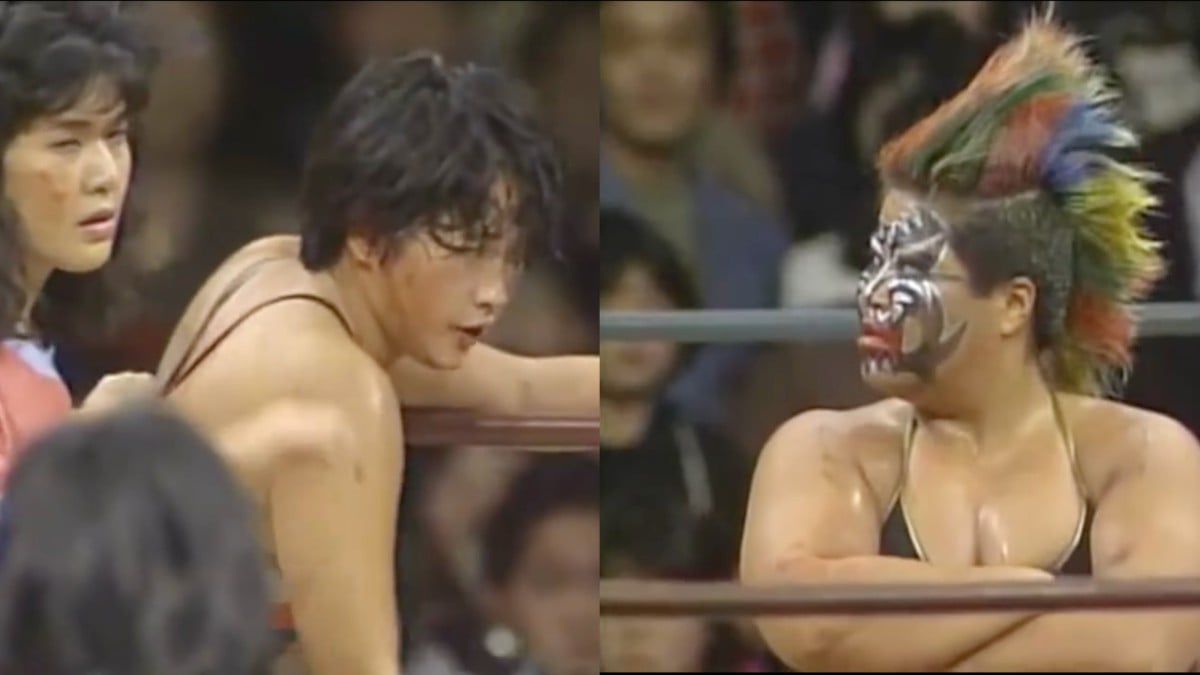
The Crush Gals, Lioness Asuka and Chigusa Nagayo, whose feud with Dump Matsumoto drew over 20 percent television ratings and defined joshi wrestling’s golden era in Japan. Photo Credit: AJW.
Chigusa Nagayo’s victory marked the beginning of the end for AJW’s golden era. The promotion maintained a strict internal policy that female wrestlers were expected to retire at age 26, reflecting broader societal pressures toward domestic life in the mid-twenties. The rule forced both Dump Matsumoto and the Crush Gals to step away at the height of their popularity. Matsumoto officially retired in February 1988, followed by the Crush Gals in May 1989.
What made those departures so damaging was not simply the loss of talented performers, but the loss of a cultural ecosystem that had taken a decade to build.
At the height of the boom in 1985, AJW ran 300 matches a year to packed venues across Japan, merchandise sales at individual events exceeded 10 million yen, and television ratings had climbed above 20 percent. That level of mainstream penetration was not a product of wrestling alone. It was the product of specific, unrepeatable personalities who had crossed over into youth culture in a way that transcended the sport entirely.
The rivalry between Dump Matsumoto and the Crush Gals had been the engine driving all of it. Their feud had generated the kind of genuine, uncontrollable emotional investment that no promotion can manufacture twice.
When both sides walked away within a year of each other, they took that engine with them. AJW’s television program was moved to a midnight timeslot almost immediately after the Crush Gals retired, a telling signal of where the promotion stood in the broader cultural conversation.
AJW did not disappear. The early 1990s brought a new boom period built around a remarkable generation of in-ring performers, including Bull Nakano, Akira Hokuto, Aja Kong, and Manami Toyota, who produced some of the most technically accomplished women’s wrestling ever seen. But that era appealed increasingly to a conventional male wrestling audience, while the Crush Gals phenomenon had been driven almost entirely by young female fans, a crossover into mainstream youth culture that no subsequent performer would replicate. What followed was exceptional wrestling, but a different kind of phenomenon, one that never quite recaptured the mainstream crossover energy the Crush Gals rivalry had produced at its peak.
Pro Wrestling Stories is committed to accurate, unbiased wrestling content rigorously fact-checked and verified by our team of researchers and editors. Any inaccuracies are quickly corrected, with updates timestamped in the article's byline header.
Got a correction, tip, or story idea for Pro Wrestling Stories? Contact us! Learn about our editorial standards here. Ever wanted to learn more about the people behind Pro Wrestling Stories? Meet our authors! Want to write for us? Learn how to join the team.
Quick Tip for Facebook Readers
Many of our readers find us through
our Facebook page.
Meta's built in browser (which opens by default on mobile) can occasionally freeze mid article, a known issue unrelated to our site.
For uninterrupted reading: tap the three dots in the top right corner then select 'Open in external browser'.
That usually resolves the glitch. Thanks for your support and we want your wrestling stories to stay as smooth as a top rope hurricanrana!
ProWrestlingStories.com participates in affiliate marketing programs. This post may contain affiliate links, meaning we may earn commissions at no extra cost to our readers. This supports our mission to deliver free content for you to enjoy!
If you love movies and pro wrestling, don’t sleep on this one.Grindhouse, Arthouse, and Wrestling Flicks by Pro Wrestling Stories Senior Editor Evan Ginzburg dives into the fascinating world where cinema and wrestling collide. Packed with hundreds of reviews, hidden gems, and fascinating turns from wrestlers on the big screen, it covers everyone from André the Giant and Roddy Piper to CM Punk, DDP, Chris Jericho, Pat Roach, and The Rock. Smart, passionate, and endlessly browsable, it’s the kind of book fans will keep returning to. Grab your copy today!
Rutvik Keche is a seasoned author with a sharp eye for the untold stories behind the spectacle of professional wrestling. While once captivated by pyros and promos, he soon found his true passion in uncovering the complex backstage politics and power plays that shape the wrestling world. Drawing from years of research and an instinct for narrative nuance, Rutvik specializes in dissecting the messy, unscripted moments that spark locker room tensions and shift industry dynamics. If it’s controversial, underreported, or buried in shoot interviews, chances are he’s already three rabbit holes deep and documenting every twist.
 Author: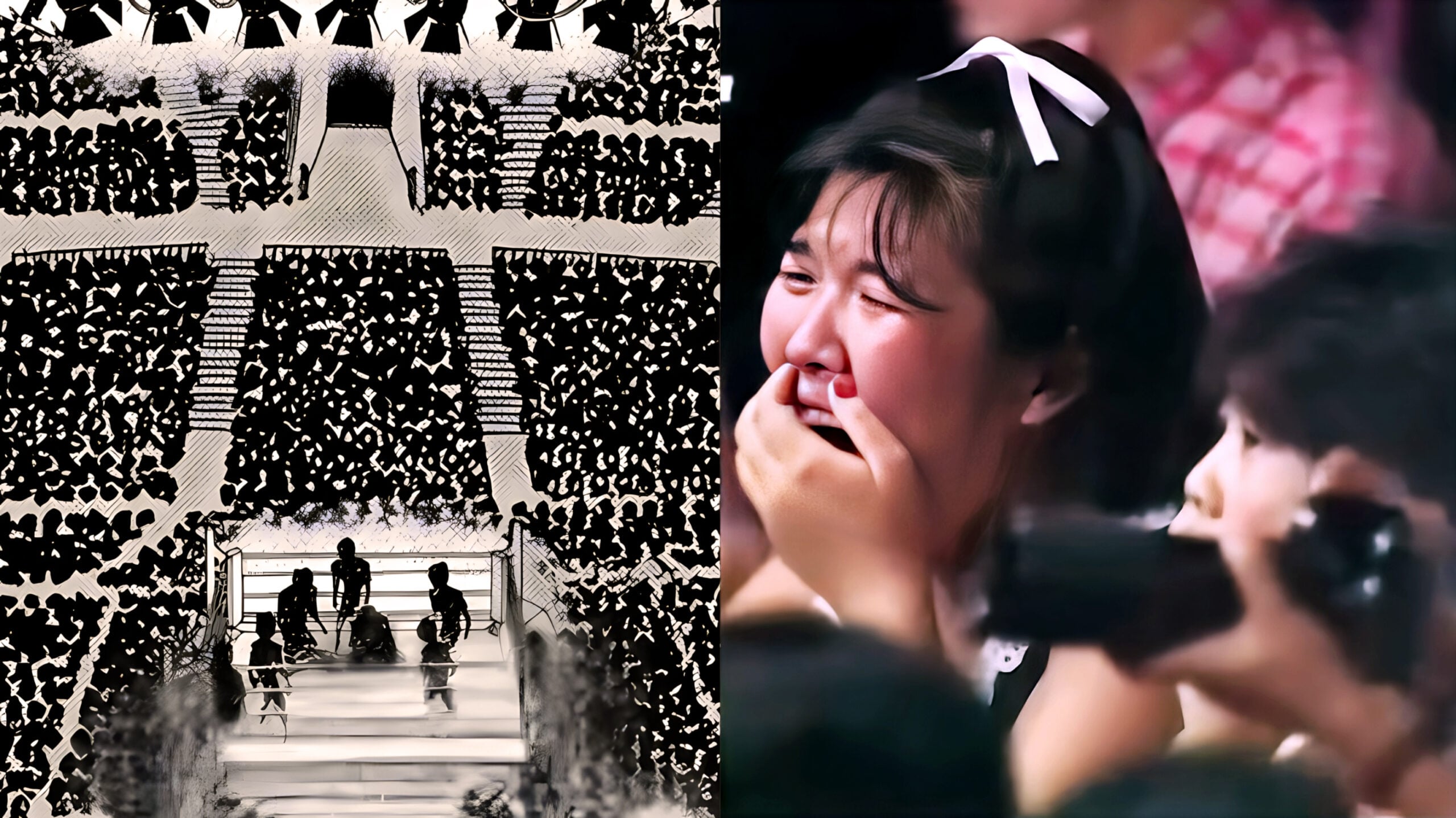






 If you love movies and pro wrestling, don’t sleep on this one.
Grindhouse, Arthouse, and Wrestling Flicks by Pro Wrestling Stories Senior Editor Evan Ginzburg dives into the fascinating world where cinema and wrestling collide. Packed with hundreds of reviews, hidden gems, and fascinating turns from wrestlers on the big screen, it covers everyone from André the Giant and Roddy Piper to CM Punk, DDP, Chris Jericho, Pat Roach, and The Rock. Smart, passionate, and endlessly browsable, it’s the kind of book fans will keep returning to. Grab your copy today!
If you love movies and pro wrestling, don’t sleep on this one.
Grindhouse, Arthouse, and Wrestling Flicks by Pro Wrestling Stories Senior Editor Evan Ginzburg dives into the fascinating world where cinema and wrestling collide. Packed with hundreds of reviews, hidden gems, and fascinating turns from wrestlers on the big screen, it covers everyone from André the Giant and Roddy Piper to CM Punk, DDP, Chris Jericho, Pat Roach, and The Rock. Smart, passionate, and endlessly browsable, it’s the kind of book fans will keep returning to. Grab your copy today!


