Author:
 At 7 feet tall and around 700 pounds, Terrible Ted the Wrestling Bear was an imposing sight. Equally remarkable was his near 20-year professional wrestling career, which saw this declawed, detoothed black bear booked and promoted like any other territorial headliner. He once lived under the legendary Hart family’s porch in Calgary, and at one point, he even spent nights in a county jail cell. With hindsight, the image of a muzzled, surgically altered animal being marched into rings for laughs and ticket sales reads far more grim than promoters ever admitted.
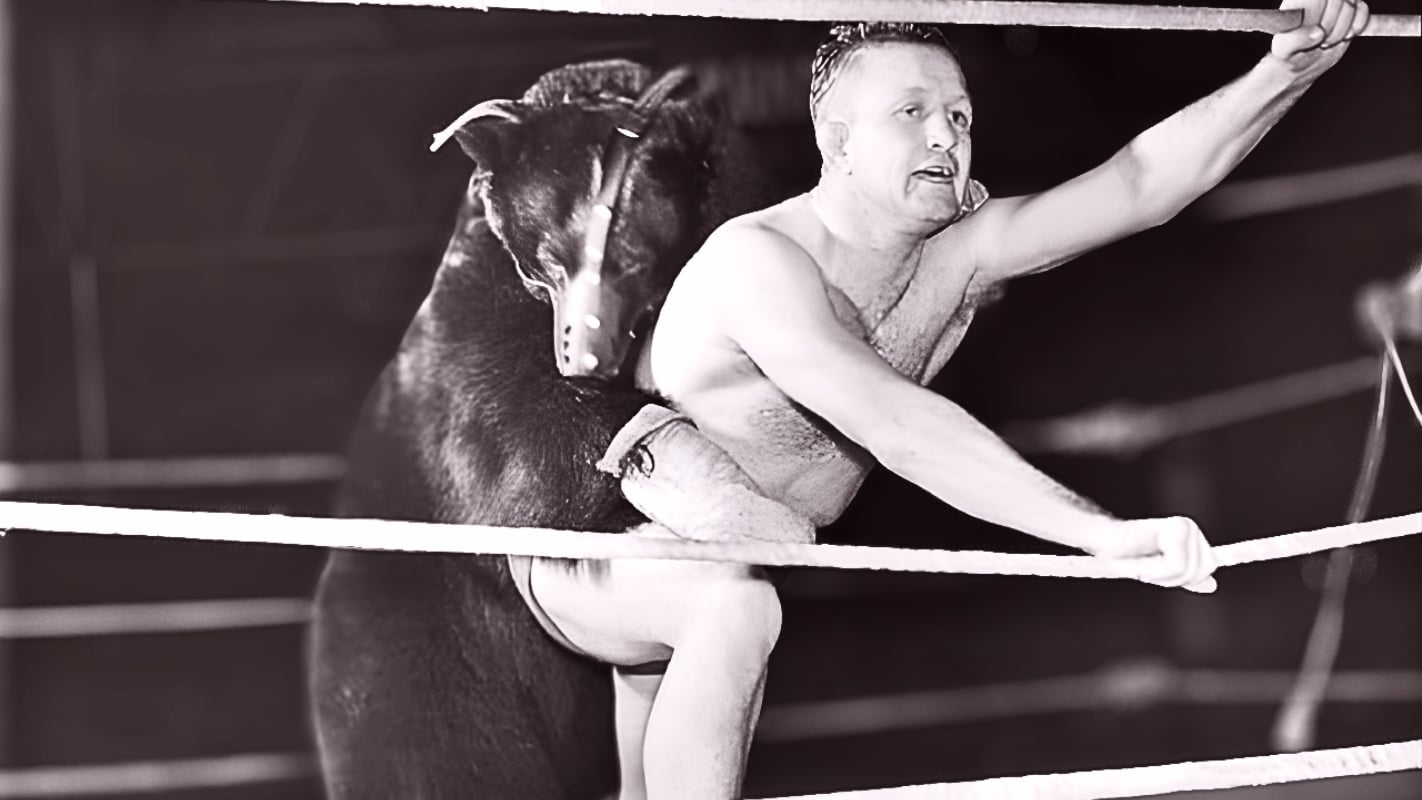
"Ted wasn’t a happy bear, and I wasn’t a happy wrestler." – Superstar Billy Graham, recalling a 1971 San Francisco bout in his autobiography Tangled Ropes (2006).
Terrible Ted The Wrestling Bear’s Wild Traveling Career
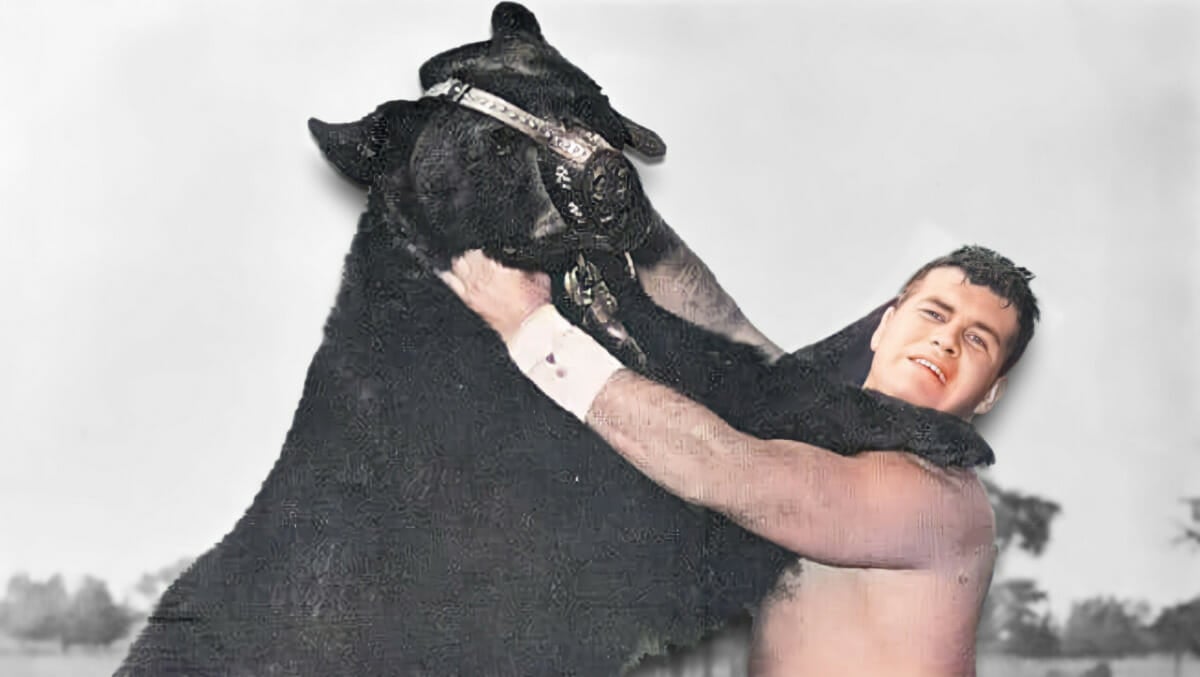
Terrible Ted was a Canadian-American black bear, born around 1949 or 1950, who wrestled across North America from the early 1950s into the mid-1970s. Reports place "Ted the Wrestling Bear" debuting on April 1, 1950, in Asbury Park, New Jersey, against former boxer Tony Galento, with rematches in Florida and Ohio later that spring, though timelines suggest those appearances may have featured a different bear working under a similar name.
In his early years, Ted traveled with a carnival, where he was declawed, had most of his teeth removed, and was trained to grapple humans while wearing a muzzle.
When the carnival went bankrupt in the early 1950s, Ontario wrestler Dave McKigney – known under various names including Gene or Jean Dubois, The Canadian Wildman, and "Bearman" – adopted and trained him, turning the bear into a touring attraction for Maple Leaf Wrestling in Toronto, Stampede Wrestling in western Canada, and assorted American territories.
By 1959, Regina’s Leader-Post reported that Ted had won more than 500 matches in his five-year career, nearly all of them worked to showcase the bear’s strength while keeping human opponents relatively safe.
In 1960-61, he wrestled extensively in the southern United States, losing only twice in 24 bouts (to Gypsy Joe and Man Mountain Managoff) and even winning a notable eight-on-one handicap match over a team that included Angelo Savoldi and Don Kent.
Ted’s itinerary reads like a tour of the territorial map. He appeared regularly at Maple Leaf Gardens in Toronto, worked loops for Georgia Championship Wrestling, and wrestled for Roy Shire’s San Francisco territory, Stampede Wrestling, the World Wrestling Association (WWA), and even the World Wide Wrestling Federation, the precursor to today’s WWE.
In 1971, he debuted for the WWWF in Pittsburgh against The Beast, and the following year, he teamed with Rocky Johnson in the WWA to defeat Luke Graham and Fritz von Goering, later pinning both Bobby Heenan and Baron von Raschke in a handicap match.
Promoters loved the visual. Terrible Ted was booked in battle royals, novelty eight-on-one bouts, and occasional mixed tags, sometimes teaming with babyfaces like Pepper Gomez or Rocky Johnson, other times presented as a sideshow monster flattening local heroes.
Records list his last known match as a bout against McKigney himself on March 29, 1975, in Akron, Ohio, closing a career that had blurred the line between carnival act and televised pro wrestling attraction.
Terrible Ted The Wrestling Bear In Court And County Jail

One of the most famous Terrible Ted stories began in Cobourg, Ontario, where McKigney offered $3,000 to any man who could pin the bear. On July 13, 1966, 36-year-old welder John Szigeti accepted the challenge at Toronto’s Maple Leaf Gardens, reportedly pinning Ted "for maybe 15 seconds" before McKigney broke the hold, only to be denied the advertised prize. In true carny fashion, McKigney and local promoter Howard Darvin refused payment, leading Szigeti to file a lawsuit in May 1968 that made newspapers across Ontario.
Things escalated further in October 1970 in Valdosta, Georgia. McKigney again advertised a large cash prize, this time $1,500, to anyone willing to wrestle Ted. A 350-pound construction worker named Ed Williams signed up, only to be told shortly before the bout that the bear had developed a bad temperament and the match was off. Williams accused McKigney of reneging on the deal, obtained a writ of attachment, and had Ted seized by local authorities as security pending the dispute.
For several days, Terrible Ted was held in the Lowndes County jail, effectively "arrested" as collateral until McKigney posted $3,000 bail and promised to appear in court. The surreal image of a wrestling bear checked into a Southern jail cell made the wire services and later became part of the territory’s lore, preserved today in photographs of the Sheriff’s handwritten note left for the Bearman.
Inside The Ring With Terrible Ted The Wrestling Bear

In an October 1975 appearance at a boat show inside the Charlotte Convention Center, Pro Wrestling Stories author and historian Ted Holland stepped onto a small platform to tie up with Terrible Ted in front of a live crowd.
Holland recalled that after two hesitant volunteers produced little, handler Gene DeBuque – another name used by McKigney – invited him in, where they locked up collar-and-elbow, and he managed to slip the bear into a headlock before Ted casually swatted him down, sat on his back, and began licking him with a long tongue as the crowd roared.
That playful scene carried a darker undertone. Holland’s girlfriend later scolded him, insisting this was "the same bear that bit off Johnny Hyman’s hand," referring to a Charlotte Memorial Stadium show around 1961 or 1962 where Crockett regular Johnny Hyman wrestled Ted in a special attraction bout. According to Holland, Hyman’s hand slipped inside the bear’s muzzle mid-match, and Ted clamped down, leaving the wrestler needing roughly thirty stitches to repair torn fingers – a reminder that even declawed and detoothed, a 600‑plus‑pound animal could still do serious damage.
Wrestlers at the top of the card remembered Terrible Ted in similarly vivid terms. Superstar Billy Graham later wrote that he could still feel the bear’s coarse fur and smell its breath as it stared at him through its muzzle during their San Francisco bout, concluding simply, "Ted wasn’t a happy bear, and I wasn’t a happy wrestler."
Bobby Heenan recalled that Terrible Ted could execute a monkey flip and a flying mare, and that at the end of some matches Heenan would wrap a towel around the bear’s neck and mime choking him, with Ted obligingly lying down to "sell" the spot like any other worker, all while the wrestler risked being doused in urine when the restless animal felt the cold arena floor beneath the mat in winter.
Bret Hart’s Childhood With Terrible Ted The Wrestling Bear
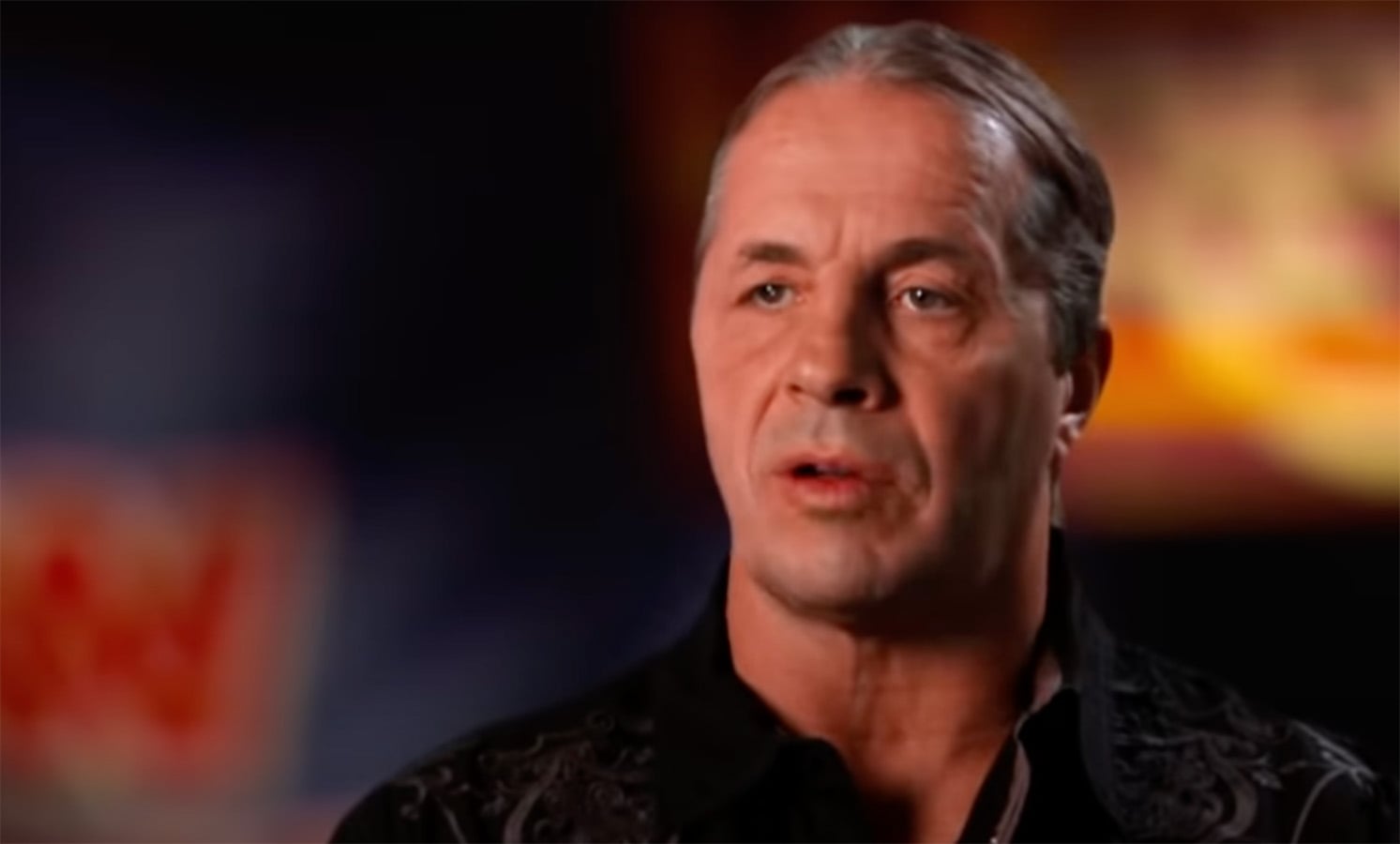
Briefly, during one of his Stampede Wrestling stints, Terrible Ted lived in a mesh cage under the back porch steps at the Hart family home in Calgary, turning a suburban backyard into something out of a traveling show. In his autobiography Hitman: My Real Life in the Cartoon World of Wrestling, Bret Hart remembered dangling bare feet through the porch slats and letting ice cream drip onto his toes so the bear could lick them clean, a strange ritual that felt perfectly normal to the Hart children at the time.
One of Bret’s favorite memories came at a neighbor’s birthday party taped at Calgary’s CFCN studios for a kids’ program called The Headhunter Show. As he told it, Terrible Ted was led onto the set to tussle playfully with handler Gene Dubois and promote that week’s Stampede card. When the host later asked young Bret if he would like a bear like that in his backyard, he matter‑of‑factly answered that he already had a bear that size living under his porch, only to be treated as a child with an overactive imagination in front of the TV cameras.
After the taping, Bret rushed home, still stinging from not being believed, and his mother, Helen, greeted him with a hug, telling him that no one believed her stories about life in the Hart house either. For the Hart kids, Terrible Ted was less a monstrous attraction and more a messy, powerful neighbor who licked Fudgesicle drips off their toes before heading back out to slam wrestlers in front of paying crowds.
With hundreds of amazing Pro Wrestling Stories to dive into, where do you start? Get the inside scoop – join our exclusive community of wrestling fans! Receive 10 hand-picked stories curated just for YOU, exclusive weekly content, and an instant welcome gift when you sign up today!
Other Wrestling Bears, Ada Ash, And A Changing Era
Terrible Ted was part of a broader, uncomfortable tradition in pro wrestling: man‑versus‑bear attractions that promoters treated as crowd‑pleasing novelties. In Alabama, vintage photos and local coverage remember bears such as Terrible Ted, Sampson, Victor the Bear, and Ginger working bars, fairs, and community arenas, including matches that would eventually lead to state legislation. When Pro Wrestling Stories’ Ted Holland looked back on his own Charlotte run‑in with Terrible Ted, he noted that Victor and Ginger were two other bears working the circuit around the same time, each with their own trainers and routes.
Perhaps the most famous of those other animals was Victor the Wrestling Bear, a brown bear exhibited by trainer Tuffy Truesdell, who wrestled thousands of fans and wrestlers from the 1960s into the 1980s, often de‑clawed, de‑fanged, heavily muzzled, and sometimes sedated. Victor faced everyone from football players and newspaper reporters to respected pros like Gorgeous George, Wahoo McDaniel, and The Destroyer, and he, too, was rewarded with a bottle of Coca‑Cola after matches – a ritual echoed in Bobby Heenan’s stories about Terrible Ted being given a Coke to drink ringside after a night’s work.
The culture that produced Terrible Ted also produced performers like Ada Ash, a pioneering strongwoman and wrestler who emerged from carnival circuits in the 1930s and 1940s, performing feats such as lifting platforms with animals on them and even staging alligator- and bear-wrestling exhibitions as part of early sports‑entertainment bills. Contemporary research and 1950s timelines show her appearing on cards in territories like Chicago for promoter Fred Kohler and later on mixed shows in Georgia, illustrating how carnival sideshows, women’s wrestling, and animal attractions blurred together in an era when spectacle often took precedence over safety.
Even mainstream wrestling books of the period treated man‑versus‑animal exhibitions as part of the game’s mythology. Sid Feder’s 1952 volume Wrestling Fans’ Book mentioned earlier stars who had wrestled 350‑pound bears in circuses, while Guy LeBow’s 1950 The Wrestling Scene chronicled how grapplers came out of carnivals and barnstorming shows, reinforcing that what later became televised pro wrestling grew directly out of a world where promoters thought nothing of pitting humans against animals for a draw.
From Attraction To Animal Cruelty: Terrible Ted’s Legacy

Decades later, it is easier to see how much cruelty was baked into Terrible Ted’s act. As detailed in modern histories of bear wrestling, animals like Ted and Victor commonly had their front claws and many of their teeth removed, were kept muzzled, and were sometimes tranquilized to dull their reactions, yet were still large enough to break bones, bite off fingers, or maul handlers when something went wrong. Even under those conditions, the bears were expected to travel constantly, perform night after night under bright lights and loud crowds, and work long shows in environments where a slip in the ring could be catastrophic.
On July 2, 1978, in Aurora, Ontario, McKigney left the cage door of another bear, Smokey, open while he was outside gardening; Smokey entered the house and fatally mauled McKigney’s girlfriend, 30‑year‑old Lynn Orser, leading the Ontario Humane Society to seize the bears in his care. Contemporary reports and later summaries note that Terrible Ted had either already died by then or was among the animals confiscated, and that neither Smokey nor Ted was ever returned, with their ultimate fate left uncertain in public records.
Public sentiment slowly turned. An Alabama law passed in 1996, prompted in part by a series of matches at New Hope’s Ponderosa Club involving a later bear also billed as "Terrible Ted," made it illegal to stage bear wrestling for profit or to surgically alter bears for matches, with violations classified as a felony and animal advocates denouncing bear wrestling as cruelty "in its purest form."
Although that specific statute was repealed in 2015 as part of a purge of old laws, other state and federal animal‑cruelty statutes effectively keep such bouts out of legitimate promotions today, and even nostalgic "old‑time wrestling" events explicitly state that no real bears will be used.
Looked at from a modern vantage point, Terrible Ted’s story sits at the intersection of professional wrestling’s carnival roots and a slowly widening understanding of animal welfare. He wrestled names like Bobby Heenan, Jerry Lawler, Mad Dog Vachon, Superstar Billy Graham, Pepper Gomez, and Rocky Johnson; he lived under the Hart family’s porch and once sat alone in a Southern jail cell as collateral in a pay dispute. Yet behind the posters and TV clips was a caged wild animal, surgically altered and hauled from town to town to be wrestled for laughs, and a generation of wrestlers who risked serious injury every time they stepped into the ring with him.
In the end, Terrible Ted’s career is a reminder of just how far the wrestling business has traveled. What was once sold as a family attraction, children feeding a bear under the porch, fans lining up for a chance to "last a minute" for prize money, is now widely recognized as exploitative, and rightly so. His legacy endures not just in wild stories and faded photographs, but in the way his era helped push pro wrestling, and the wider public, toward finally retiring the idea that a muzzled, declawed bear should ever be part of the show.
These stories may also interest you:
- 5 Wrestling Animals and Their Chilling Stories Outside of the Ring
- Mad Dog Vachon Shoot Fight Stories – An Animal in and Out of the Ring
- George Steele on Becoming The Animal and His ‘Fetish’ for Turnbuckles
Can’t get enough pro wrestling history in your life? Sign up to unlock ten pro wrestling stories curated uniquely for YOU, plus subscriber-exclusive content. A special gift from us awaits after signing up!
Want More? Choose another story!
Be sure to follow us on Facebook, X/Twitter, Instagram, Threads, YouTube, TikTok, and Flipboard!
Our wrestling history is gold, and so are readers like you!
If this story added to your collection of wrestling knowledge, you can say thanks:
Tip jar (PayPal)
Browse our merch at our brand-new shop (launched February 2026)!
Pro Wrestling Stories is committed to accurate, unbiased wrestling content rigorously fact-checked and verified by our team of researchers and editors. Any inaccuracies are quickly corrected, with updates timestamped in the article's byline header.
Got a correction, tip, or story idea for Pro Wrestling Stories? Contact us! Learn about our editorial standards here. Ever wanted to learn more about the people behind Pro Wrestling Stories? Meet our authors! Want to write for us? Learn how to join the team.

ProWrestlingStories.com participates in affiliate marketing programs. This post may contain affiliate links, meaning we may earn commissions at no extra cost to our readers. This supports our mission to deliver free content for you to enjoy!
 If you love movies and pro wrestling, don’t sleep on this one.
Grindhouse, Arthouse, and Wrestling Flicks by Pro Wrestling Stories Senior Editor Evan Ginzburg dives into the fascinating world where cinema and wrestling collide. Packed with hundreds of reviews, hidden gems, and fascinating turns from wrestlers on the big screen, it covers everyone from André the Giant and Roddy Piper to CM Punk, DDP, Chris Jericho, Pat Roach, and The Rock. Smart, passionate, and endlessly browsable, it’s the kind of book fans will keep returning to. Grab your copy today!
If you love movies and pro wrestling, don’t sleep on this one.
Grindhouse, Arthouse, and Wrestling Flicks by Pro Wrestling Stories Senior Editor Evan Ginzburg dives into the fascinating world where cinema and wrestling collide. Packed with hundreds of reviews, hidden gems, and fascinating turns from wrestlers on the big screen, it covers everyone from André the Giant and Roddy Piper to CM Punk, DDP, Chris Jericho, Pat Roach, and The Rock. Smart, passionate, and endlessly browsable, it’s the kind of book fans will keep returning to. Grab your copy today!